

Beware, of his promise,/Believe, what I say
Before, I go forever/Be sure, of what you say
So he paints a pretty picture/And he tells you that he needs you
And he covers you with flowers/And he always keeps you dreaming
If he always keeps you dreaming/You won’t fear the lonely hours
If a day could last forever/You might like your ivory tower
But the night begins to turn your head around/ And you know you’re gonna lose more than you’ve found
Yes, the night begins to turn your head around
The Night – Frankie Valli and the Four Seasons

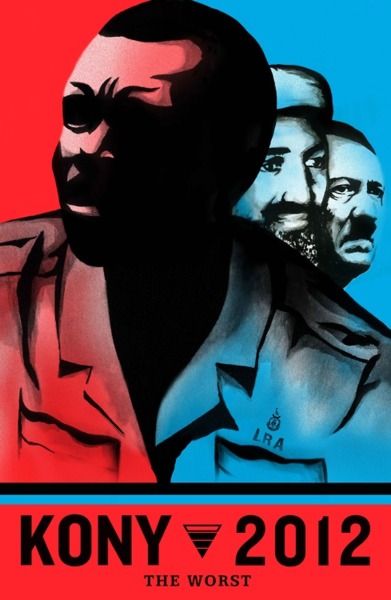
What if we took Jason Russell’s mission to ‘Cover the Night’ with Joseph Kony posters literally? Let’s take ‘the night’ in its poetic, metaphorical sense as a time of darkness, fear, illicit freedoms, predatory, carnal animality, ‘the dark night of the human soul’, and all that, and then imagine covering up this terrible dark space with endlessly duplicated, Warholesque pictures of a mass murderer.
Not a bad image really. Fair play to ‘em!
A recent editorial in Black Star News makes a last minute plea for Invisible Children (the organization founded by Jason Russell which produced Kony 2012) to call off it’s ‘Let’s Cover the Night’ plan. At a forum at New York University’s School of Law Victor Ochen asked how Americans would feel if some organization had decided to make Osama bin Laden famous by wearing bin Laden T-shirts and plastering the streets with posters to promote a military campaign to capture or kill him. As we well know, the US government didn’t need the pressure of a viral marketing campaign to get that job done. But this should not obscure the parallels between the mission to terminate both commands. A recent article in the Washington Post reports from the newest US military outpost in the Central African Republic where US Special Forces – Russell’s euphemistic ‘advisors’ – are already, allegedly, well on Kony’s case.
“The Americans have captured Osama bin Laden and Saddam Hussein,” a local tribal chief told the journalist “Surely they can catch Joseph Kony.”
There is, understandably, some scepticism about the US military presence in the region and the actual reasons for it. “The LRA has reappeared,” said Martin Modove, the head of the Catholic diocese in Obo. “The presence of the Americans has not changed anything. We just see the Americans driving or walking in town. We don’t see what they are doing to catch Kony.”
Oh dear. This does sound familiar. Some of you may recall the arrival of the US military in post-earthquake Haiti and how, as an Al Jazeera news report put it five days after the quake, ‘Most Haitians have seen little humanitarian aid so far. What they have seen is guns, and lots of them’. And not much has changed since then.
What we see in both the Kony 2012 mission and the militarization of aid in post-earthquake Haiti is the strategic manipulation of collective human sympathy towards the suffering of others as a pretext for US military intervention in countries with strategic and/or military-economic value. In October last year President Obama announced he would be sending US Special Forces on a ‘humanitarian mission’ to help defeat the LRA. US troops will only use their weapons in ‘self defence’ or, in what amounts to the same thing, in protection of the ‘national security of the United States’. Kony’s threat to the US has nothing to do with his treatment of child soldiers or the murder, rape and kidnap of thousands of civilians. It is being used as a moral pretext to divert attention from the real reasons for being in the region: the strategic economic value of Africa as a continent and the need to challenge China’s territorial control of the resources there. John Pilger has described this as part of a new ‘Scramble for Africa’.
In his article KONY 2012 and The “White Man’s Burden” Revisited Amii Omara-Otunnu draws parallels between the logic of the Kony 2012 mission the 19th century, overtly colonial, proto-NGO’s.
‘The European NGOs of the period, such as Christian missionaries, chartered commercial companies and geographical explorers, astutely manipulated the ignorance and sense of compassion among Westerners to evoke pity for Africans and in the process provided pretext, justification and support for European powers to intervene in the continent.’
‘The gist of the potent public relations strategy used by European NGOs in the nineteenth century was that European powers needed to intervene in the continent for humanitarian reasons. One compelling “humanitarian reason” retailed at the time was to abolish the slave trade and ameliorate its evil impact.’
‘What, of course, transpired as a result of the various campaigns by European NGOs in the nineteenth century was that European powers met in [sic] Berlin Conference from November 1884 to February 1885 to work out the ground rules for dividing up Africa among themselves, without due consideration of the interests of African peoples.’
The parallel strategies of Kony 2012 and the 19th century NGO’s include: directing attention towards the victims rather than the long-term, macro-political causes of their suffering; manipulating the ignorance, sentimentality and sense of compassion of people in the West in order to profit from the misery of Africans; giving the impression that primary agents in these missions are motivated by altruism rather than self-interest; and combining an image of a diabolical ‘inhuman’ tyrant with the suffering of Africans in general in order to justify imperialist military intervention in the country.
Such parallels may in part account for the fact that at some of the screenings of Kony 2012 in Uganda viewers pelted the screen with stones: a bizarre symbolic fulfilment of Jason Russell’s initial inspiration to go to Uganda in the first place.
CELEBRITY SALVATION
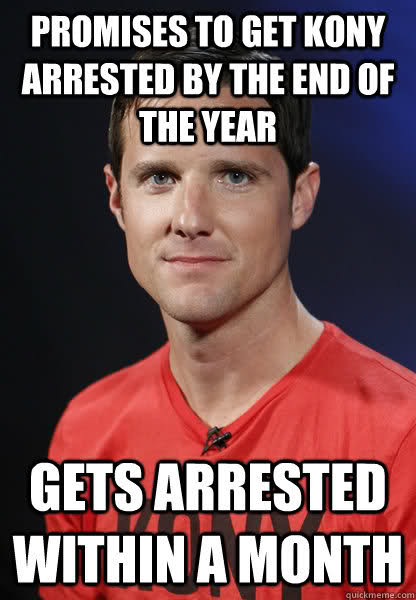
It is perhaps not surprising that Jason Russell’s thespian background would make him a big fan of the celebritariat. We could even see Kony 2012 as a sort of substitute for the genocide musical he never got to make, with his 20 ‘culture makers’ as the cast, and 12 policy makers as the backers. But there’s no more ‘waiting to be discovered’ for Jason now. There does however seem to be some dark psychology at work in Kony 2012 and the plan to ‘Make Kony Famous’. The scene where Russell tries to explain to his son the difference between the nice, good little boy – ‘just like you!’ – and the ‘evil man’ who makes little boys – ‘just like you’ – do horrible things to other little boys – ‘just like you’ – is particularly psycho. I can’t help imagining Kony’s face staring back at Russell in the mirror of his darkest dreams, the faces alternating with increasing frequency (Good Dad/Bad Dad, Good Dad/Bad Dad, Good Dad/Baghdad, Good God/Bad Dad, God Good /Dad Bad) until the face of Kony replaces his own and stares back at him, learing, Hyde-like.
Equally enjoyable in terms of this dark fantasy is the video for another of his Invisible Children projects – The Fourth Estate – a video invitation to join the new revolution. In it Kony…I mean Russell…speaks of “a new Liberty, a new Right, a Citizenship founded on the belief that all men and women in the world are created equal.”. As he speaks a faceless, silhouetted and sharply-dressed executive-type gently touches one photo on a wall of mug-shots of twenty-somethings with the their faces obscured by the word ‘Uninvited’ (Imagine the horror of not being able to take part in this world-changing fun-fest of diabolical despot terminating! Un-endurable.) In this new world, “Justice for all is not a fantasy”. Cut to the faceless deliverer of the new constitution/party invitation being chauffeured in a very expensive-looking, super-shiny-black sports-limo: “A generation that will pursue the world’s worst criminals, no matter where they hide, or who they kill, and bring them to justice. It is the future. Some of us are not ready. Most of us fear the change. Others see what could be and what is waiting to be made”. World-changing, wax-sealed letter arrives at a surprisingly skanky- looking doorway. As the letter is opened the voice tells us “The time has come for a new estate”. On August 2011 a new revolution will be mapped out. And you are invited to be part of it. Cut to shabby young man in a hoodie walking into the blinding limelight of a cinema auditorium. “You will say it all began at the Fourth Estate. Because it will’.
You shall go to the ball.
The ‘viral success’ of Kony 2012 owes much to its celebrity endorsements. As demonstrated with the immediate aftermath of the earthquake in Haiti, celebrities are quick to use the power of their fame and wealth to ‘raise awareness’ of the suffering of poor people in far off countries. A list of the top celebrity donors, the causes they give to, and – for those with strong stomachs – a catalogue of drearily predictable, sentimental slush videos can be found at Look to the Stars – The World of Charity Giving.
As George Clooney, A-list socially conscious celebrity, and one of Kony’s…I mean Russell’s…20 ‘culture makers’ put it in the video: ‘I’d like indicted war criminals to enjoy the same level of celebrity as me. That seems fair. That’s our objective. It’s to just shine a light on it’.
That Clooney and Russell apply the same theatrical metaphor of the limelight is telling here. There is, I think, a fundamental relationship, which I won’t expand any further here, between the ‘banality of sentimentality’ proposed by Teju Cole, the ‘Hello-magazine effect’ (i.e. the illusion of easy-access meritocracy generated by celebrity culture) and the popular, youthful, utopian, humanitarianism exploited by Kony 2012.
This is explicitly the case in Haiti, where US imperialism, disaster capitalism and Evangelical missions are inextricably linked. How precisely the celebrity saviour complex fits in with these processes will need to be addressed in a later post.
The White Saviour Industrial Complex would be an excellent placeholder for these themes, except that the celebritariat is not an explicitly white machine. In the case of Haiti, although Bradd Pitt and Angelina Jolie were first off the celebrity doner starting blocks – followed up by Madonna – Wyclef Jean, Oprah Winfrey and Tiger Woods were hot on their heels.
I’m not explicitly criticizing any of these individuals and their motives for wanting to raise awareness and revenue to fight for their pet humanitarian causes. What’s more interesting is how the deeper psychic mechanism of fame is mobilized for popular humanitarian causes, how this mechanism recursively endorses celebrity culture in general, perpetuates magical-thinking on the part of charity givers that their donations will actually lead to a reduction in the amount of real human suffering and diverts popular consciousness away from the real political and economic causes of that suffering.
Putting celebrity mass murderers in the limelight only casts the imperialist military-economic strategy of the US into deeper obscurity. And this is something that Evangelical Christian organizations, of the kind that Russell is personally involved in, have a fundamental role in.
 Invisible Mirrors