
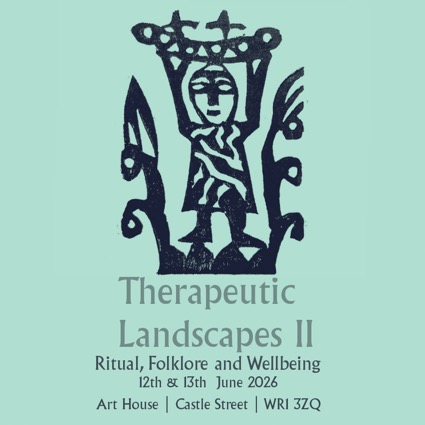
I’m very excited to announce the call for papers for ‘Therapeutic Landscapes II: Ritual, Folklore and Wellbeing’, a symposium and exhibition that will take place at The Art House at the University of Worcester on June 12th and 13th 2026.
We invite artists, creative practitioners, health practitioners, cultural historians, public health workers and curators who, both formally and informally, are investigating the intersections of ritual, folklore, magic and physical environments and their implications for emotional health and wellbeing to present their work around (but not limited to) the following themes:
• Creative placemaking through storytelling
• Artistic engagement with local knowledge, know-how and skills held in place
• Intentional embodiment in transformative practices
• Creative work that addresses class within folk cultures
• Communal creative interventions in the landscape
• Participatory archaeology/ experimental archaeology
• More than human entanglements
• The Imagined Village: speculative fiction informed by folklore
• Creative interpretation of folk objects held in museums and collections
• Public health arts-based initiatives that are informed by Folklore and folk beliefs
• Ritual as therapeutic creative practice
• Craft practices that investigate connections between making, materiality and emotional wellbeing
• Material practices exploring magic and the supernatural
• Folk customs, ritual games, and community wellbeing
• Mortality, ancestors and commemoration
• Right to roam: communities of dissent
• Mayhem mischief and misrule
• Creative interpretations of places associated with healing
• Pilgrimage, procession and pageantry
• Combatting rural loneliness and isolation through Creative Health interventions
• Local Artists and artist-led co-ops in rural places
• Nature based approaches to radical self-care
Paper Presentations
Please send 250 word abstract for a 20 minute presentation to therapeutic_landscapes@worc.ac.uk
Performances and Workshops
Proposals for longer performances and workshops are also welcome. Please send a short 250 word outline of your proposed activity.
Exhibition
Please send a short 250 word artist statement and up to 6 images of your work for consideration for the exhibition.
Deadline for proposals : 1st March 2026
Presenters and participants will be notified 14th March 2026.
Email: therapeutic_landscapes@worc.ac.uk
Instagram: https://www.instagram.com/folk.cultures.research/


 Invisible Mirrors