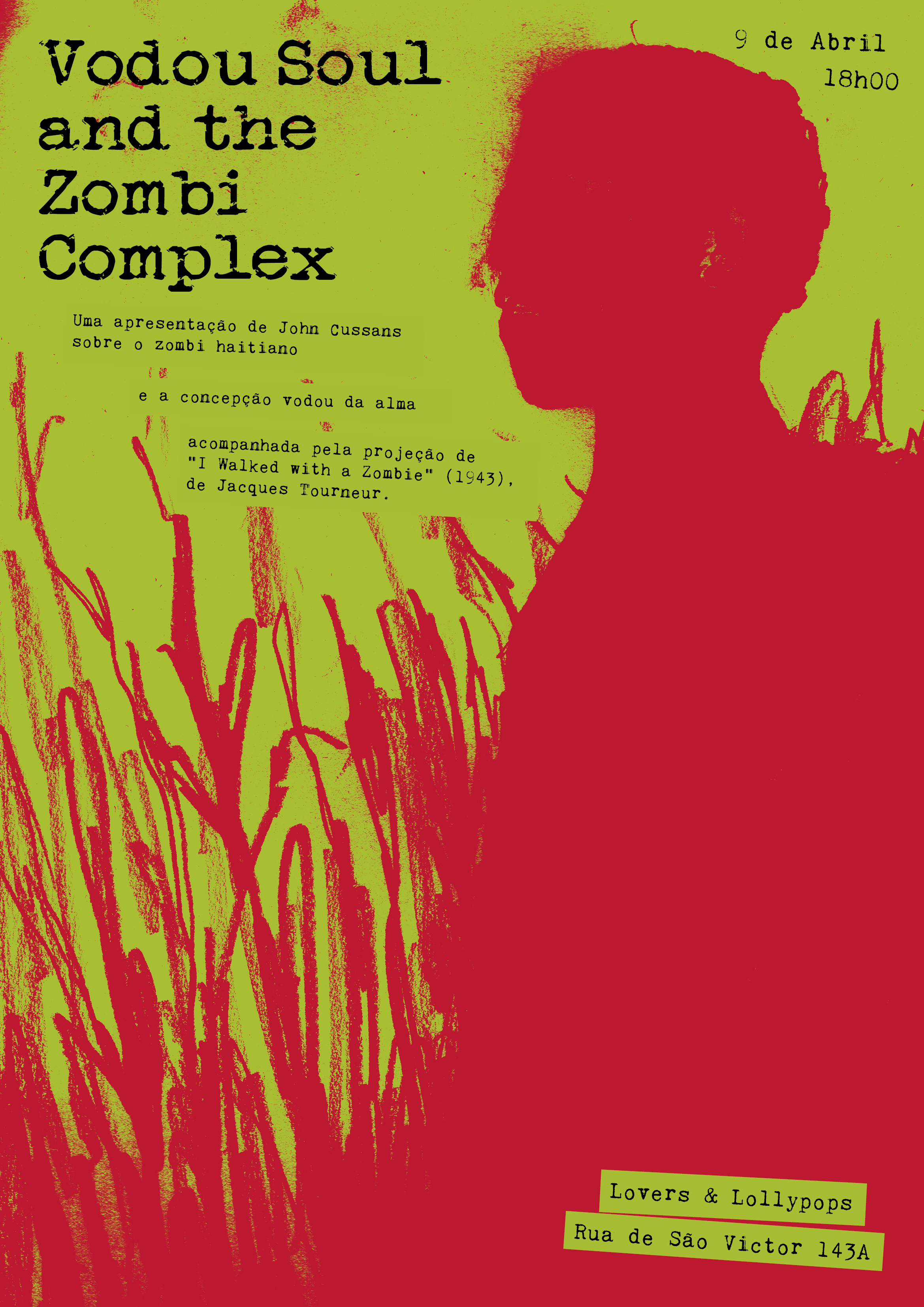
If anyone is in Porto next week please come along to my talk ‘Vodou Soul and and Zombi Complex’ at Lovers and Lollypops on Thursday 9th April at 18.00.
Lendl Barcelos will be playing a DJ set from 18.00. My talk will be from 19.00 – 19.30 followed by a screening of Jacques Tourneur’s I Walked with a Zombie (1943), the most artful of the classic Haitian Zombie movies. There will be a post-film discussion after the screening.
My colleague Leah Gordon has created a JustGiving campaign to raise funds to store and transport a group of Atis Rezistans artworks from LA to New Orleans. You can read more about the situation in the link. Please share the campaign with your networks.
The situation in Port-au-prince is deteriorating rapidly and the gangs appear to be systematically targeting the Grand Rue region which was home to Atis Rezistans as well as a rich and vibrant informal economy.
At least three former participants in the Ghetto Biennale have been killed in the last couple of months, caught in cross-fire between gangs and police. Most of the artists have had to move to other neighbourhoods, losing all their possessions, separated from family and community and having to find huge deposits for higher rents.
Leah Gordon has organised a pop-up one night exhibition at Ruby Cruel in Hackney (London) on Saturday August 31st 2024 from 6pm – 9pm to help raise money for the artists’ relocation and plain survival costs. There will be works for sale by Andre Eugene, Jean Claude Saintilus, Wesner Bazile, Getho Jean Baptiste, and many more. This is a one-night crazy price bonanza! There will also be many art works donated made by former Ghetto Biennale participants. So come along and get a great piece of art.
Haitian music and cocktails!
Ruby Cruel 250 Morning Lane, London E9 6RQ
Hackney Central or Homerton Overground Station or Bethnal Green tube
I will be giving a lecture about my work at the Royal Academy Schools in London on Monday March 6th at 11.30. If you would like to attend please email me (j.cussans@gmail.com) and I’ll put you on the guest list. The lecture will be in three sections:
1. Ritual Practice : Veve Kunigundis
Focussing on the ritual drawings I make with Roberto N. Peyre, specifically Veve Kunigundis made during documenta15.
2. Drawing Analogies : Invisible Machines
Focussing on a chapter about ‘Psychoanalytic Imaginaries and Paranoid Critical Theory’ from the book on diagrams I’m writing with David Burrows, Dean Kenning and Mary Yacoob
3. Critical Arts : Health Humanities
Reframing critical and socially engaged arts practices from a mental health and wellbeing perspective
I was very happy to have conversation recently with J G Michael on his excellent podcast Parallax Views. J.G. asked some excellent questions that allowed us to dig deeper than usual into the historical, psychological and contemporary political implications of the zombie complex.
In it we discuss conceptions of the soul in Haitian Vodou; its role in the revolution and later suppression; primitivism, negrophilia and the romance of revolutionary Vodou amongst avant-garde intellectuals; George Bataille’s ideas about revolutionary violence, excess and General Economy; the notion of somnambulistic trance in debates about cinema and mass media; Papa Doc Duvalier’s political use of Vodou during the dictatorship; and US-UK anti-Vodou Black Ops in the 1940’s and Cold War .
It was good to be drawn into a theoretical discussion about J.G’s interview with Frank B. Wilderson III, author of Afropessimism, and to air some grievances about Wade Davis, author of Serpent and the Rainbow (1985).
A call for artists and curators (calls in Kreyòl, 官话, Português, لغة العربية, Español, русский, Ελληνικά, Deutsche, Français, नॉट available soon on the website) http://www.ghettobiennale.org
‘Every form of enslavement generates in one way or another an opposing struggle for liberation’ Carolyn E. Fick, The Making of Haiti, (The University of Tennessee Press 1990)
The Haitian Revolution, possibly one of the most important and overlooked, revolutions of the world appears to have been written out of Western history.
‘The silencing of the Haitian Revolution is only a chapter within a narrative of global domination. It is part of the history of the West.’ Michel-Rolph Trouillot, Silencing The Past, (Beacon Press, Boston 1995)
We welcome projects that both memorialise, and challenge the memorialization of, the Haitian Revolution. We are looking for alternate narratives to the Slaves Revolt. We invite complex readings of the leaders as well as alternate histories from below. We encourage non-binary, queer, surreal and magic versions of the slaves revolt.
We ask for historically reflective, contemporarily comparative and future speculative projects which use the Haitian Slaves Revolt as a starting point.
‘The paradox between the discourse of freedom and the practice of slavery marked the ascendancy of a succession of Western nations within the early modern global economy.’ Susan Buck-Morss, Hegel, Haiti and Universal History, (University of Pittsburg Press 2009)
The 6th Ghetto Biennale 2019 will take place from the 29th November until the 20th December 2017. All works must be made and exhibited in Haiti. Artists and curators will be invited to pass, no less than ten days and up to three weeks in Haiti before presenting their work in the neighbourhood.
The deadline for proposal applications is midnight Sun 28th April BST and our decisions will be made and announced by mid-May.
In an earlier post (23/12/15) I mentioned an incident that occurred during the penultimate night of the Ghetto Biennale in which a young man from Lakou Cheri, Gerard Masalen, died after a fight with another man. I think it is important to write something here about the circumstances surrounding Gerard’s death within the broader context of GB IV, the political tensions in the streets of Port-au-Prince at the time of the biennale and the experiences of some of the participants and guests that have not been widely discussed or publicly shared. The main issue I’m trying to tease out here has to do with the complex relationship between the actual and perceived risks for artists participating in the biennale, the implicitly economic and often fraught nature of inter-personal relations between visitors and locals, and how the perceptions and realities of such are understood, represented and managed by the GB organization.
My own contribution to this year’s biennale was a “gossip wall” hung within Lakou Cheri, the main site of the biennale, on which local people and visitors were invited to write anonymous stories about what was going on “off-screen” as it were. I would collect any gossip at the end of each day, then wipe the canvas clean ready for the following one. The idea was to create a kind of local gossip column that would potentially give voice to dissenting or critical opinions about the biennale. This was part of a broader project conceived as a means to gather material for an essay in the forthcoming Ghetto Biennale catalogue that would be based, in part, on the opinions of people outside the biennale’s inner circle. I mention this to frame my comments here in terms of the broader project I was involved in during the biennale. That being said, my account of the circumstances leading up to and following the events that night is primarily a personal one, supported by details gleaned from conversations with biennale guests during and after the event, witnesses, members of the organizational team and people who knew Gerard personally.
“REacting shows a lack of control, an inability to stay cool/clearheaded under pressure. Pwen songs push the point in a way that circumvents the need for reaction.” – Houngan Matt
A recent twitter spat between Robin Mackay (Urbanomic) and Nick Land over at Outside/In has prompted me to write a second ‘In the Blood’ post.
On the surface the exchange is about whether there might be genetic factors determining the quality of electronic music created by certain races. It began with Nick’s suggestion that contemporary accelerationism would benefit from a ‘new pulse of darkside electronic music’ that, in his ‘hardcore racist’ opinion, would most likely come from the Black Atlantic. Robin’s surprised reaction to Nick’s claim that no such thing could come out of China prompted Nick to ask if this was because ‘the notion of overwhelming racial patterns in compulsive rhythmo-memetics is so obviously implausible?’ To Robin’s response ‘“Natural Rhythm” Omg, Omg, Omg’, Nick’s ‘Less-Evil’ twin shaded “Is “omg omg omg” supposed to be some kind of exhibition of natural rhythm?” After Robin’s fruitless search for any darkside, cyber-apocalyptic electronic music coming out of China, Nick duly noted that he’d perhaps been “Pwned by DNA”.
Now in Haitian folklore the word pwen has multiple cultural meanings and inflections. Derived from the Kreyol for “point”, it is specifically associated with the communication of meaning and the special “charge” of the mystères in Vodou song and ceremony. To be “pwened’ then, is to have pointed contact with energies of the loa (Vodou spirits). A pwen is a first brush with the loa that precedes full possession. It also means, in popular parlance, to be hexed, and, appropriately, given the conversation above, to be insulted (as in the contemporary ‘pwn’, on-line, gamer “elite-speak” for being defeated in a computer game, or “owned”).
Which brings me, somewhat circuitously, to the recent ‘Communities in Conversation’ event hosted by the Konsthalle C in Hökaränge suburb of Stockholm. The event included presentations from various people who had been involved in the Ghetto Biennale, including Leah Gordon, Roberto N. Peyre, André Eugène and Jean Claude Saintilus. I presented, in diagram form, the basic schema for the current chapter of Undead Uprising, based loosely upon Romero’s Night of the Living Dead, which attempts to describe and account for the bifurcation of the zombie complex around 1968, mentioned in this previous post. I had hoped that a public presentation might help me break the conceptual bottleneck I seemed to be stuck in. This post is a second shot at that.
Intrigued by the persistent use of the term by journalists and other commentators on Haiti I’ve been doing a little research into the origin of common epithet for Haiti, a country which has been described variously as an economic basket case, an environmental basket case or more generally the basket case of the western hemisphere. It seems that the first use of the expression in relation to Haiti was by Lars Schoultz in his 1981 book Human Rights and United States Policy Towards Latin America since when it has become something of a reflex journalistic cliché for anyone seeking to represent the Haitian nation as an irredeemably damaged and incurable political-economic entity.
A brief review of the history of the expression itself is revealing. The term was first used officially at the time of WW1 by the Surgeon General of the US armed forces in an attempt to quell potentially demoralizing rumors amongst military personnel that hospitals were filling up with men who had lost both sets of limbs in battle and, as a consequence, were being transported home in baskets (Oxford English Dictionary, 2nd Edition). Similar rumors began to circulate again during the second world war. Interestingly for Haiti, the first recorded use of the term in the context of international relations was a reference made in a 1967 British newspaper article suggesting that the political solutions proposed for southern Africa by Kwame Nkrumah – the Pan-African independence leader and first president of Ghana – did not make him a basket case. This seems to be the first time the expression was used to describe a mental rather than physical state of irreparable damage or disability. Importantly, from the perspective of Haiti, Nkrumah brings together the association of unworkable agricultural and economic policies in post-colonial nations with the idea of African despotism. Like several Haitian presidents before François “Papa Doc” Duvalier, Nkrumah also eventually made himself ‘president for life’. However by the 1970’s the term “basket case” was also being applied to the disastrous national agricultural policies of European states like Bavaria and Italy. Interestingly the two themes of post-colonial national independence and disastrous agricultural policy have recently been brought together in the frequently repeated simile: from bread basket to basket case. Behind these different levels of meaning there is often a sense that a basket case nation is usually led by a basket case president.
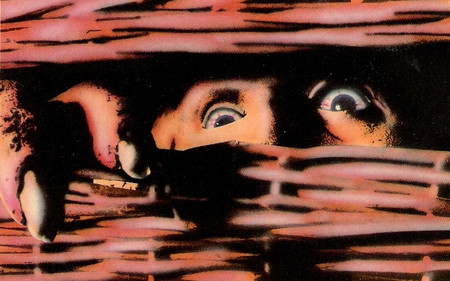
Horror film fans will probably be more familiar with the use of the term to describe a person driven irredeemably insane by terror, like these unfortunate gentlemen who made the big mistake of watching a sexploitation horror double-bill: The Blood Spattered Bride (1972) and I Dismember Mama (1974). The term was given a new lease of life with the release of Frank Henenlotter’s 1982 comedy-gore exploitation film Basket Case in which the able-bodied brother of siamese twins carries around his mutant and murderous twin Belial – named after the Judaic demon identified in the Dead Sea Scrolls as leader of the Sons of Darkness – in a basket.
On a more controversial and “neoreactionary” note (for Zombi Diaspora at least) Mark Krikorian, author of The New Case Against Immigration (2008), has argued that Haiti’s basket case status is due in part to the fact it it was not colonized for long enough (the argument being that the revolution cut short the possibility of Haitian’s benefiting from ‘the more advanced civilization of the colonizers’) and partly, echoing sentiments expressed by Lawrence Harrison elsewhere, because of ‘the strength of paganism, in the form of voodoo’ that the French ‘weren’t around long enough to suppress’.
In fact there have been ongoing systematic attempts to suppress and eradicate Vodou from Hispaniola since well before the revolution, and long after. And it was not only the French who sought to rid the island of this unruly ancestor cult but also many of the Haitian leaders themselves (later in cahoots with the US army and Catholic Church). That being said Duvalier’s overt public embrace and political use of Vodou as a source of noiriste Afrocentric nationalism didn’t exactly help the religion’s reputation in the outside world. By the time of this rare interviewwith Alan Whicker in 1969 the difference between actual basket cases caused by war, the thousands of psychological basket cases produced by his reign of terror, and the mind ‘Voodoo Dictator’ himself had become abysmally undifferentiated.



 Invisible Mirrors