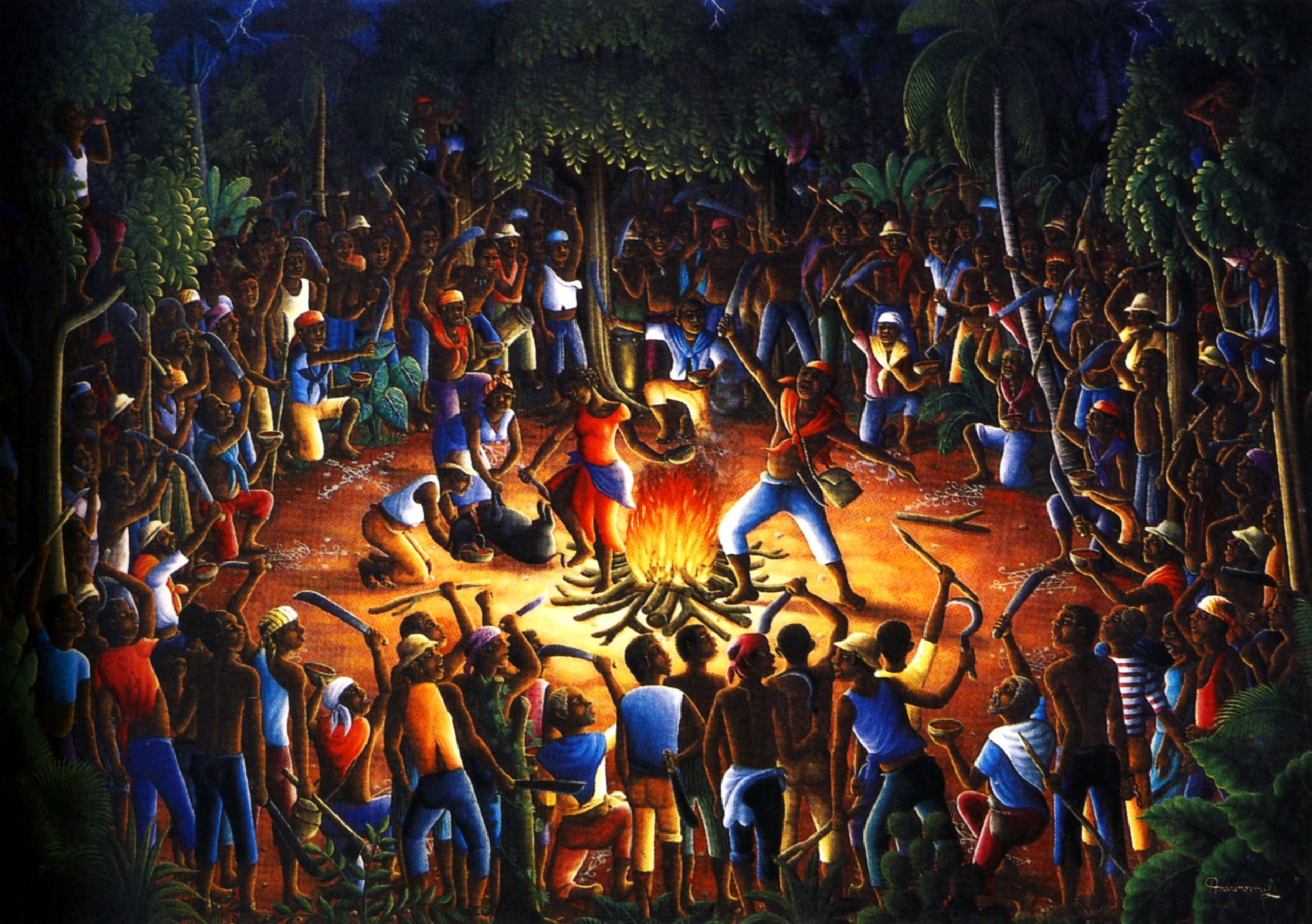
Andre Normil Ceremonie du Bois-Caiman (1990)
‘With only slight exaggeration, one can say that the reputation of vodou as a unifying and revolutionary force begins with the ceremony of Bois Caiman.’ David Geggus
There is a scene in the 1967 film adaptation of Graham Greene’s novel The Comedians that, somewhat unexpectedly, touches upon the conclusion of the talk I recently gave at the October Gallery. In the scene Philipot, the artist nephew of the murdered Minister for Social Welfare whose body was found at the beginning of the story in the empty swimming pool at the Hotel Trianon, explains to the morose and faithless-realist hotel-owner Brown that he is going to a Vodou ceremony that night to summon the African gods who will help him fight the Tonton Macoutes and overthrow the Duvalier dictatorship. The particular loa to be summoned will be Ogoun Ferraille, a Dahomean warrior and metalworker spirit who has been syncretized in Haitian vodou with Saint Jacques Majeur (or Saint James the Moor Slayer). “My grandmother came from Africa” Philipot tells Brown proudly, “and her gods are the only ones that can help me now. I’ve pretended to be western for too long”. During the ceremony, in which a black cock is sacrificed by an unlikely looking (though reputedly authentic) houngan, Joseph, the bartender at the Trianon, is possessed by the spirit of Ogoun Ferraille, spraying the terrified Philipot with rum and tapping his palms and soles with a flat of a machete before the young painter is initiated into the warrior cult. Ogoun Ferraille, along with Erzulie Dantor, Mambo Marinette and Ti Jean Petro are the four loa most commonly associated with the legendary Bois Caïman ceremony that reputedly ignited the first uprisings of the Haitian revolution in August 1791.
Despite the general acceptance of the myth in most popular accounts of the revolution, some Haiti scholars have disputed whether the ceremony actually took place, and one in particular, Léon-François Hoffmann, proposed in 1991 that the story was fabricated by a “malevolent” French colonist and plantation physician, Antoine Dalmas, whose intention was to denigrate the slaves and distance the French elites from the African insurgents. Hoffmann’s claims were tendentious within the Haitian studies community at the time and the debate was rekindled by the publication of David Geggus’ Haitian Revolutionary Studies in 2002. After taking a thorough look at Hoffmann’s claims, sources and alternative accounts, Geggus concludes that a ritual ceremony probably did take place sometime around August 21st, but that the facts pertaining to it, which are thin on the ground, have been significantly embellished by subsequent historians seeking to emphasize the African and slave-led currents within the revolution (and therefore at the foundation of the Haitian nation).
Dalmas’ account is based on the testimony of three slaves captured after an initial, well-documented public gathering of the “slave elites” (coach-drivers and slave-drivers) from 100 different plantations at the Lenormand De Mézy estate on Sunday August 14th. An alleged smaller gathering took place a few days later in a wooded area called La Caïman (the Alligator) at which a pig was sacrificed, its blood drunk and its hairs taken to make protective amulets. According to Dalmas the captives said that the pig was “surrounded by fetishes” and sacrificed “to the all-powerful spirit of the black race”. And that was it.
By 1953 the Haitian historian and diplomat Dantès Bellegarde described the Bois Caîman ceremony in ways that had by then become familiar to all elite-educated school children in Haiti:
‘During the night of 14 August 1791 in the midst of a forest called Bois Caïman, on the Morne Rouge in the northern plain, the slaves held a large meeting to draw up a final plan for a general revolt. They consisted of about two hundred slave drivers, sent from various plantations in the region. Presiding over the assembly was a black man named Boukman, whose fiery words exalted the conspirators. Before they separated, they held amidst a violent rainstorm an impressive ceremony, so as to solemnize the undertakings they made. While the storm raged and lightning shot across the sky, a tall black woman appeared suddenly in the center of the gathering. Armed with a long, pointed knife that she waved above her head, she performed a sinister dance singing an African song, which the others, face down against the ground, repeated as a chorus. A black pig was then dragged in front of her and she split it open with her knife. The animal’s blood was collected in a wooden bowl and served still foaming to each delegate. At a signal from the priestess, they all threw themselves on their knees and swore blindly to obey the orders of Boukman, who had been proclaimed the supreme chief of the rebellion. He announced as his choice of principal lieutenants Jean Francois Papillon, Georges Biassou, and Jeannot’. (From Histoire du Peuple Haïtien, 1953)
So how did the story of Bois Caïman develop from such a basic schematic account to the established myth we know today? And more specifically how did the characters Dutty Boukman, houngan, rebel leader and author of the legendary Boukman Prayer, the mambo Cécile Fatiman, the old priestess and the loa Erzulie Dantor, Ogoun Ferraille, Marinette, Ti Jean Petro, all find themselves cast into this “operetta sanguinaire” of Haitian independence?
That’s what I tried to account for at the October gallery talk. It goes something like this:
Continue reading “Bois Caïman and the Romance of Revolutionary Vodou” Invisible Mirrors