We will be launching our book Drawing Analogies: Diagrams in Art, Theory and Practice at The Gallery, Slade School of Fine Art, UCL, Gower Street, London, WC1E 6BT on Thursday May 1st at 18.00.
The launch will be accompanied by invited academics presenting on their research and discussing diagrams with the Diagram Research Group.
The invited academics are:
Dr. Winnie Soon, artist & Director of UG Art & Technology (Slade School of Fine Art UCL
Duncan Greig, Professor of Genetics (Centre of Life’s Origins and Evolution/CLOE)
Martin Holbraad, Professor of Anthropology (UCL Anthropology)
Drawing Analogies is published by Bloomsbury Press as part of the ‘Drawing In’ series as a hardback book and open access publication that can be downloaded here.
There will be refreshments. For information and attendance e-mail David Burrows: d.burrows@ucl.ac.uk
My new book Drawing Analogies: Diagrams in Art, Theory and Practice, co-authored with David Burrows, Dean Kenning and Mary Yacoob, is available as Open Access here. The print edition will be available to buy here from 6th Feb 2025.
Informed by Charles Sanders Peirce’s understanding of a diagram as an analogy of relations, Drawing Analogies draws on its authors’ creative use of diagrams as artists, educators and arts researchers, and on fields of inquiry that bring the arts into alignment with other disciplines, most notably anthropology, critical theory, pedagogy, philosophy, psychology, semiotics and the physical and life sciences.
By taking an artistic approach to diagrams and diagramming, by incorporating diagramming as a method of enquiry within chapters, and by exploring their interdisciplinary and multi-perspectival potentials, Drawing Analogies proposes giving new life to the art of diagramming and widening the arena of artistic practice and creative research.
David Burrows, Dean Kenning and Mary Yacoob will be discussing our forthcoming book Drawing Analogies: Diagrams in Art, Theory and Practice at The Photographers’ Gallery on Tuesday June 25th between 6.30 and 8 pm. The event is free but limited. Places can be booked here.
I will be giving a lecture about my work at the Royal Academy Schools in London on Monday March 6th at 11.30. If you would like to attend please email me (j.cussans@gmail.com) and I’ll put you on the guest list. The lecture will be in three sections:
1. Ritual Practice : Veve Kunigundis
Focussing on the ritual drawings I make with Roberto N. Peyre, specifically Veve Kunigundis made during documenta15.
2. Drawing Analogies : Invisible Machines
Focussing on a chapter about ‘Psychoanalytic Imaginaries and Paranoid Critical Theory’ from the book on diagrams I’m writing with David Burrows, Dean Kenning and Mary Yacoob
3. Critical Arts : Health Humanities
Reframing critical and socially engaged arts practices from a mental health and wellbeing perspective
Below is an edited transcript of a talk I gave at the first DRUGG (Diagram Research, Use and Generation Group) gathering at University College London on July 14th and 15th 2012.
Fred Astaire and Hermes Pan, RKO Publicity Shot (1939)
Introduction
Diagrams play a fundamental role in the art of teaching, helping people do and understand things in ways that differ from and complement other teaching methods. Diagrams can be defined as visualisations of non-apparent systems, concepts, relationships, processes and ideas. They help students to recognise and understand parallels and structural correlations between things in the world; their constitutive natures; their internal structures; relationships; the systems of which they form a part; the processes they are involved with; their own physicality and subjectivity; the coming-into-being of all of these through time and space; and theoretical explanations for these becomings.
As visual and drawn objects with a pedagogical function, one might expect diagrams and diagramming to be established institutional objects and practices in art and design education. This is however rarely the case. Although diagrams and diagramming are often used in lectures, as tutorial aids and in student notebooks, they are seldom addressed in art education on their own terms. Having taught art theory and academic writing to art and design students for many years now, I have found them increasingly useful as teaching tools, particularly for helping students see and understand relationships between philosophical concepts, art theory, art making, thinking and writing.
Later I will try to construct a practical, systematic schematisation of diagrams. But for now I will simply include ‘diagrams’, ‘analogies’, ‘allegories’, ‘maps’, ‘plans’ ‘models’, ‘schema’, ‘pictograms’ and ‘technical illustrations’ in the category of things we might conveniently describe as diagrammatic. Generally they all combine, in an ostensibly unitary form, words, pictures, lines, figures, shapes, numerals, forms, axis, grids and tables. The diagrammatic in this sense is can be characterised by the following attributes: (1) graphic visualisation, (2) an economy of graphic means that minimise extraneous information (3) a high-level of representational and conceptual abstraction, (4) the representation of non-apparent systems and relations and (5) a generally didactic purpose. Later we will see that some of the key philosophers concerned with the diagrammatic depart significantly from this signifying, purposive and didactic schematisation.
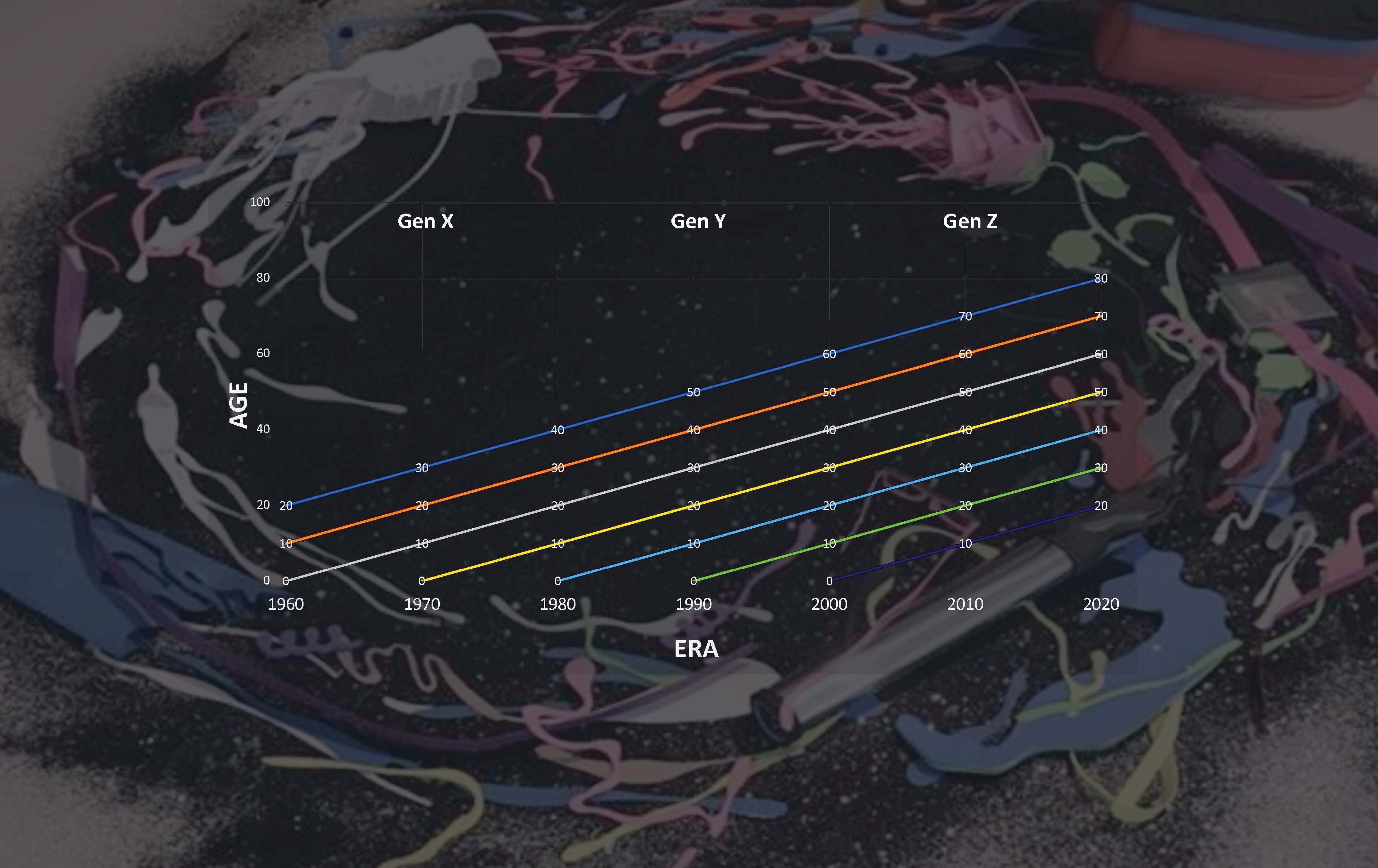
Image: David Burrows, Detail of ‘Diagram of the Event Horizon of a Black Hole (following Susskind’s Holographic Theory): Blind Date Implosion’ (2018) combined with John Cussans’ Inter Generational Matrix (no date).
Diagram Research Group (DRG) – David Burrows, John Cussans, Dean Kenning and Mary Yacoob – are currently undertaking an online residency at Flat Time House (F T I-Io), the former home and studio of the artist John Latham, now his archive and a gallery space.
During the one month residency we will conduct four illustrated online discussions that explore our interests in diagrams in relation to Latham’s ideas about flat time, the unification of scientific and artistic bodies of knowledge and the primacy of time and event (rather than space and matter).
Each session will be led by one member of the group and form part of an ongoing, illustrated online conversation, the documentation of which will be added each week to the Delta (Δ) Research Placement site.
In my session I will discuss Latham’s 20th century art-science convergence diagram in relation to a general shift in artistic consciousness from the 1950’s onwards from material object to temporal event; problems of temporal-historical consciousness within art, art history and art education; and parallels between Latham’s thought and practice and that of Alfred Korzybski, founder of General Semantics and author of Science and Sanity (1933).
Schedule
DRG Event I: David Burrows Dwelling Place for Thought/ Plane of the Least Event
I’m very excited about the forthcoming show Morphologies of Invisible Agents that will take place at Space Studios in Hackney between the 26th April and 18th May. The show has been generated through a collaborative project led by Martin Holbraad (UCL) and David Burrows (Slade) that brings together anthropologists and artists with a shared interest in diagrams. I have been working with Kelly Fagan Robinson, an anthropologist working on disability, communication and applied public policy.
The exhibition will have a soft opening on Friday April 26th and a formal Private View on Thursday May 2nd between 6 and 9 pm. The participating artists are David Burrows, Lucy Cash, John Cussans, Melanie Jackson, Dean Kenning, Lucy A Sames and Hermione Spriggs. The participating anthropologists are Narges Ansari, Igor Cherstich, Martin Holbraad, Kelly Fagan Robinson, Julia Sauma, Kaya Uzel.
There is a program of scheduled public events, including presentations by myself and Dean Kenning on Saturday May 4th, when I will be presenting part 2 of my ‘BC Time-Slip/Cannibal Metaphysics’ lecture, the first half of which can be seen here. There will also be performances during the exhibition by AAS and Plastique Fantastique. Details forthcoming…




 Invisible Mirrors