NAFAE Annual Conference 2025 Call for Papers

This year’s National Association of Fine Art Education conference – Culture Co-operative: Moments, Spaces, and Alternatives for Art and Cultures of Learning will be hosted by the Feral Art School in Hull on Friday April 25th.

The themes of this conference follow on from those of the 2024 NAFAE Conference The Art of Resistance and the arguments of the recent book Cooperative Education, Politics, and Art: Creative, Critical, and Community Resistance to Corporate Higher Education.

The deadline for proposals is March 3rd and confirmation on the 17th. More details about the conference themes and the submission process can be found here.

Re-Imagining Aesthetic Education for Creative Health

I will be presenting my paper ‘From the Education of the Senses to Creative Health: Re-Imagining Aesthetic Education for the 21st Century’ at the Northern School of Contemporary Dance’s annual conference ‘Igniting Creativity’ on the 8th of January in Leeds. Tickets for the event can be booked here and you can see the schedule here.

Here’s a summary of what I’ll be addressing in my talk:

‘Contemporary British culture is wrought with seemingly intractable economic conflicts and social inequities, particularly in the areas of education, health and the arts. Yet despite poor prospects of future financial rewards, young people still choose creative arts degrees all over the UK.

The values that bring young people into arts education – improving mental health, meaning, non-conformity, play, self-expression, social critique, social justice – have all been embedded in the arts since the beginning of 20th century, but they fall outside accountable metrics of the socio-economic good.

Paradoxically, as regional arts programs struggle to survive, the government’s Creative Health agenda is gaining national momentum. Is there a way for us to revitalise the 19th century ideal of art as an “education of the senses”, reconnect it to the broader project of improving individual and social wellbeing though increased sensory awareness and embodied cognition, and align it more closely with Creative Health?’

I will also be involved in workshops and discussions led by Friends of the Future, a newly established community interest company supporting, educating and offering connection to mental health professionals and community artists who are providing creative activities to individuals and communities in and around the Yorkshire region. We will be launching our website at the event.

Generative AI and Arts Education: The Case of Fine Art

Here is the outline for the presentation I will be giving at the Homo ex MachinAI event in Athens next week.

In this presentation I will discuss my use of generative AI tools for teaching BA Fine Art and their implications for arts education more widely.

In his influential essay ‘The Work of Art in the Age of Mechanical Reproduction’ (1935), the German art critic Walter Benjamin famously argued that the meaning and social function of art would be irrevocably transformed by photography’s erosion of the unique art object and its “aura”. Almost a century later, and despite major changes in the way art is made, discussed and experienced, contemporary fine art remains essentially a studio-based activity through which individuals versed in art history, theory and philosophy, create unique, singular artworks that are publicly experienced by humans using their full range of senses. 

Using examples from my teaching, I will argue that generative AI tools like Midjourney and ChatGPT will impact the practice and teaching of those arts more closely tied to business and screen-based media (advertising, animation, game arts, illustration, marketing, photography, etc.) more significantly than those that create unique artefacts and events based on the lived experience of individuals and groups, encountered by other humans in real space and time (dance, fine art, performance, theatre, etc.).

The peculiarly anachronistic, experiential and deeply humanistic character of fine art and fine art education, and a long history of highly-evolved philosophy and critical theory reflecting on its paradoxical nature, mean that: i) fine art is less likely to be impacted by generative AI than more commercially-orientated practices and ii) having already ridden out and survived several perceived existential threats posed by new technologies and the social environments they create, it is well-prepared for ‘the coming wave’.

Arts education and education more generally, however, are already being impacted and transformed by generative AI tools. How fine art education will fare in an environment of hybrid teaching methods, AI-enhanced personal learning tools and AI-assisted grading and feedback is another matter. 

DRG@FTI-Io

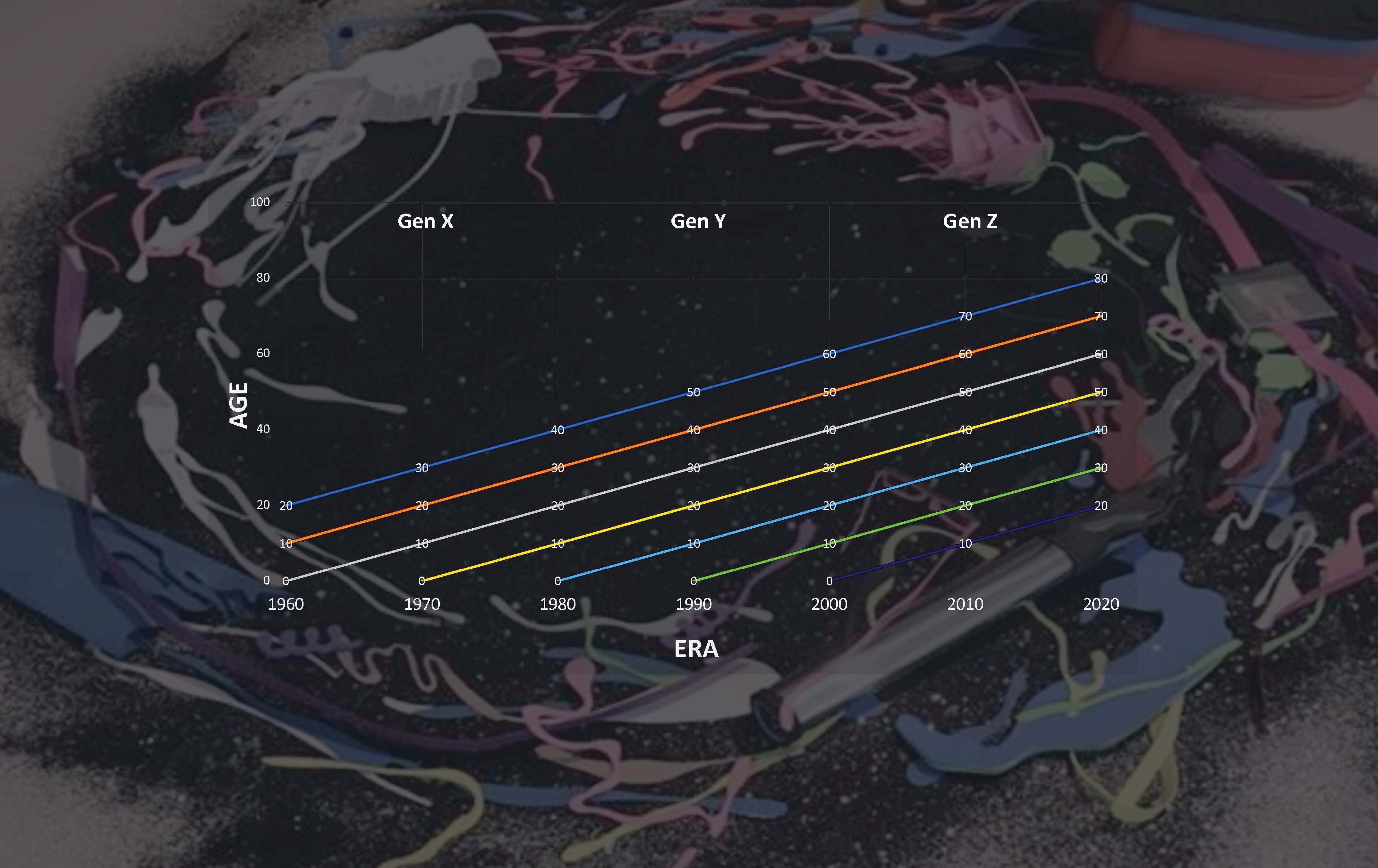
Image: David Burrows, Detail of ‘Diagram of the Event Horizon of a Black Hole (following Susskind’s Holographic Theory): Blind Date Implosion’ (2018) combined with John Cussans’ Inter Generational Matrix (no date).

Diagram Research Group (DRG) – David Burrows, John Cussans, Dean Kenning and Mary Yacoob – are currently undertaking an online residency at Flat Time House (F T I-Io), the former home and studio of the artist John Latham, now his archive and a gallery space.

During the one month residency we will conduct four illustrated online discussions that explore our interests in diagrams in relation to Latham’s ideas about flat time, the unification of scientific and artistic bodies of knowledge and the primacy of time and event (rather than space and matter). 

Each session will be led by one member of the group and form part of an ongoing, illustrated online conversation, the documentation of which will be added each week to the Delta (Δ) Research Placement site.

In my session I will discuss Latham’s 20th century art-science convergence diagram in relation to a general shift in artistic consciousness from the 1950’s onwards from material object to temporal event; problems of temporal-historical consciousness within art, art history and art education; and parallels between Latham’s thought and practice and that of Alfred Korzybski, founder of General Semantics and author of Science and Sanity (1933).

Schedule

DRG Event I: David Burrows
Dwelling Place for Thought/ Plane of the Least Event 

Available here.

DRG Event II: Mary Yacoob
Addressing Space-Time Diagrams, Kinetics, Notation, and Flat Time

Available here.

DRG Event III: John Cussans
The Librarian’s Outburst – Explosive Orality, Cosmic Consciousness and the Art Event/Event of Art

Available here.

DRG Event IV: Dean Kenning
Available from Friday 6 November
The Riddle of Time Diagram. Entropy, Value and the Social Function of Art

Art, Possession and The Revolutionary Unconscious

Below is an illustrated transcript of a lecture I recently gave at the Museum of Ethnography in Stockholm as part of the Xism show and ‘Pig Party’ event curated by Roberto Peyre to coincide with a major Vodou exhibition currently taking place there. I will be writing about the Vodou show and the discussion surrounding it in further posts. I will also post a transcript of the lecture I gave two days later as part of the ‘Sacred Matter and Secular Frames’ symposium organized by Lotten Gustafsson, Curator at the Museum of Ethnography and the National Museum of World Culture. Continue reading “Art, Possession and The Revolutionary Unconscious”