A Taste for Blood and Truth: Bill Gunn’s Ganja and Hess (1973)

I’m very excited to have a chapter on Bill Gunn’s 1973 experimental vampire film Ganja and Hess in Scared Sacred: Idolatry, Religion and Worship in the Horror Film.
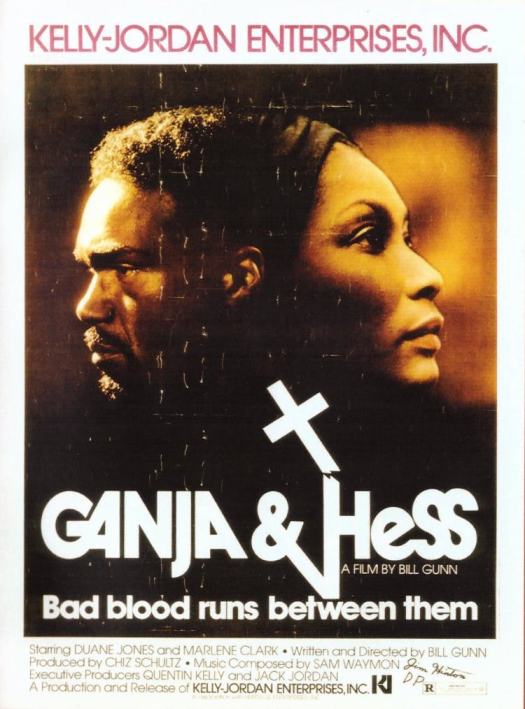
Often discussed as an audacious subversion of the Blaxploitation genre by a maverick Black director, Bill Gunn’s 1973 “vampire film” Ganja and Hess is a complex meditation on the psychology of race, religion, sex, class and addiction in 1970’s America. The narrative is framed as a conflict between the redemptive power of the blood of Christ offered by the Black Church, and a fantasy of ancestral African sovereignty represented by the Myrthian blood-cult. The film is also an important vehicle for Gunn’s personal experiences as a Black artist struggling for creative autonomy and critical recognition in a White-run culture industry, and living with the damaging psychological consequences of existing between seemingly incompatible worlds. Drawing specifically on the Cameroonian philosopher Achille Mbembe’s writings on Blackness, the chapter discusses the religious and moral meanings of Ganja and Hess from the perspectives of its lead characters and the lives of the actors who played them.
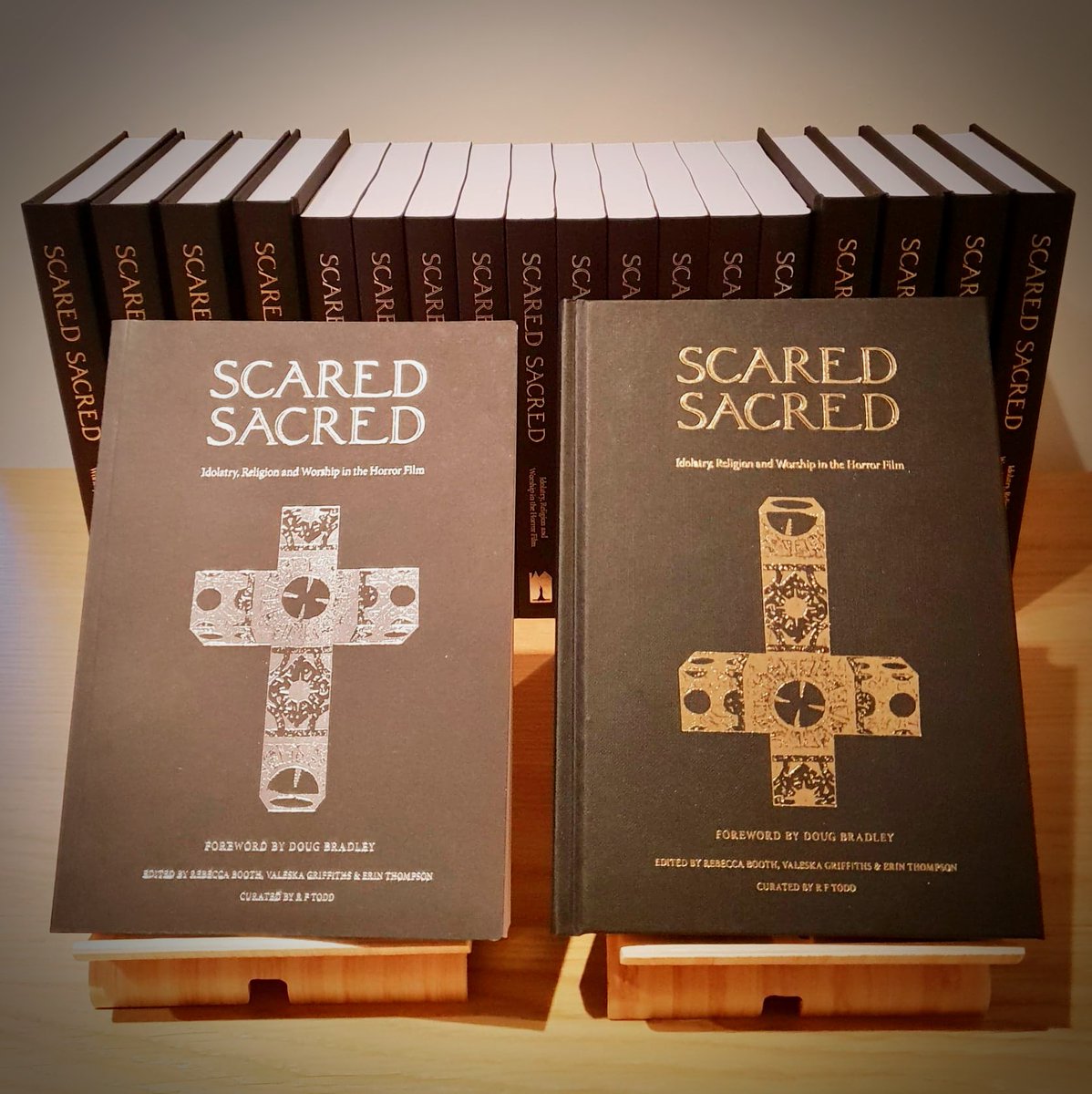
The hardback edition of Scared Sacred has now sold out, but the paperback is available to buy here.

The Disintegrating Chronotope of Philip K. Dick (Redux)

I am reposting this transcription of a lecture I gave to MA Fine Art students at Chelsea College of Art and Design in Winter 2008. It will give some context to a forthcoming series of blog posts related to the BC Time-Slip project and to a program of lectures I will be giving for Fine Art and Psychology students at the University of Worcester in the forthcoming academic year. The first of these – ‘Beware the Boa Constructor! Freud, Modern Art and the Riddle of Interpretation’ – is in the pipeline.


The Disintegrating Chronotope of Philip K. Dick (1928 – 1982)

Part One

Introduction

‘Artists are replicants who have found the secret of their obsolescence’ – Brian Massumi ‘The Simulacrum According to Deleuze and Guattari’ (1987)

The term replicant here is a reference to Ridley Scott’s Blade Runner (1982), the name he gave to the androids in his film version of Philip K Dick’s novel Do Androids Dream of Electric Sheep (1968). The plot of Dick’s novel revolves around a number of highly ‘evolved’ robots who are seeking to have the date of their in-built obsolescence postponed indefinitely. It is the blade runner’s job to hunt down and prematurely terminate the rebellious androids. Although Blade Runner lacks much of the narrative content and philosophical themes of Dick’s original novel, the film brought Dick the mainstream attention he had sought throughout his 25 years of science fiction writing. Sadly, in characteristically tragi-cosmic fashion, he did not live long enough to enjoy his new found fame.

The broader context for this lecture are the themes of historical and temporal consciousness we have been exploring in relation to the shift from modern to postmodern thought, aesthetics and cultural theory, and in particular the ‘materialist’ conception of history addressed by Benjamin in the ‘Theses on the Philosophy of History’ and throughout Illuminations.

Continue reading “The Disintegrating Chronotope of Philip K. Dick (Redux)”

Freud, Psychoanalysis and Culture: Lockdown Lecture Series

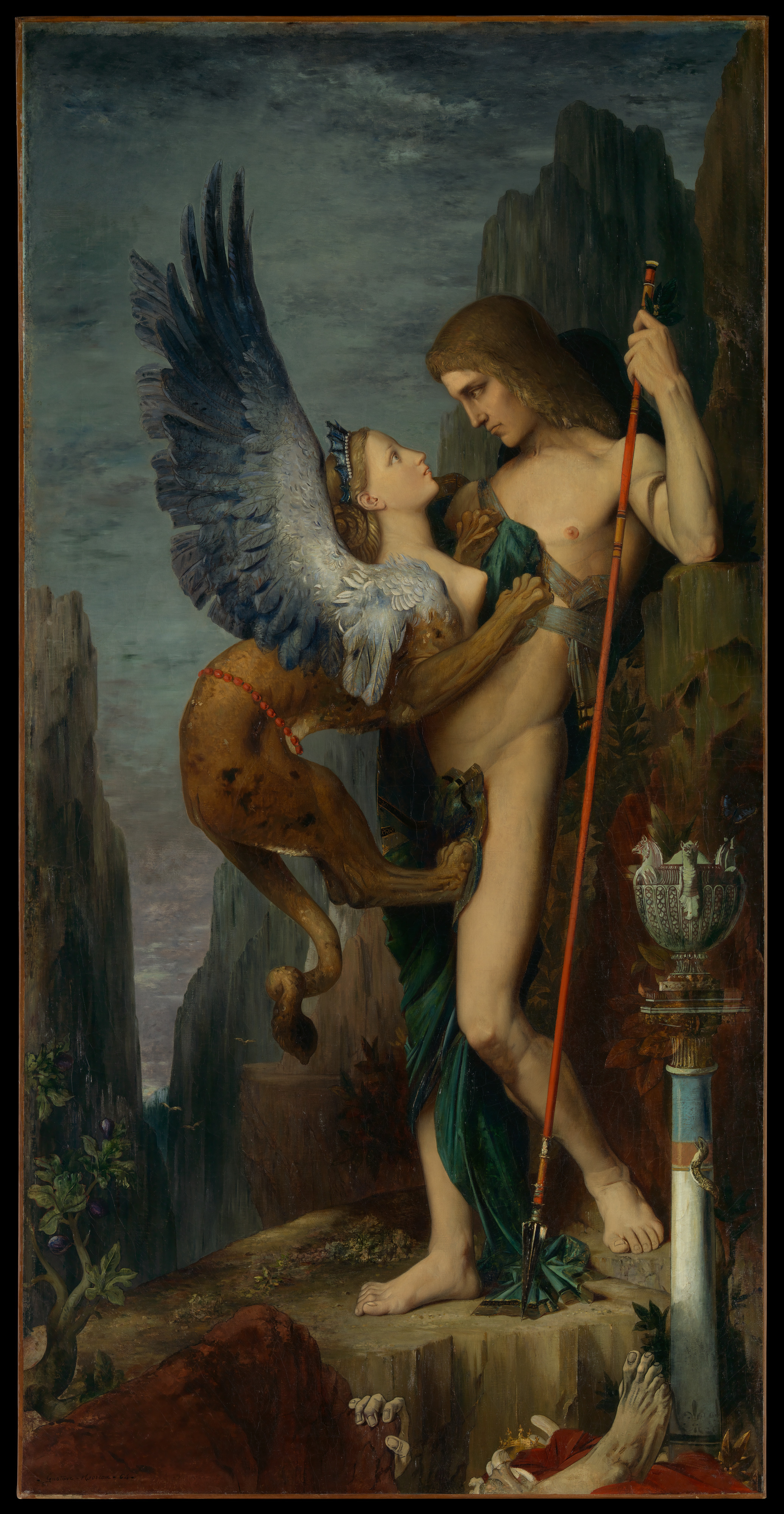
Oedipus_and_the_Sphinx Gustave Moreau 1864

I will be giving a presentation for the Freud, Psychoanalysis and Culture Lockdown Lecture Series, organised by Dr Luke Devine at the University of Worcester, on Monday 13th July at 5 pm. The lectures will take place online and details can be found in the link.

My talk Beware the Boa Constructor! Freud, Modern Art and the Riddle of Interpretation takes its title from the art historian Erwin Panofsky, who would warn his students against ignoring historical facts for the convenience of a compelling theory. Ernst Gombrich made reference to the ‘boa constructor’ in his 1984 lecture on Freud’s aesthetic theory ‘Verbal Wit as a Paradigm of Art’, where he used it as an example of a play on words that reveals a ‘trapdoor’ to the unconscious. Most of Freud’s references to the Fine Arts were classical and he was famously unmoved by modern movements like Expressionism and Surrealism which purportedly brought the artists unconscious into aesthetic form. For Freud an artist’s unconscious should be mediated by the technical traditions and cultural conventions of established art forms rather than trying to subvert or transgress them. The riddle of interpretation for modern art is exemplified by Freud’s pre-occupation with Michelangelo’s sculpture of Moses, which had a formative role in his own auto-analysis, exemplifying his struggle against academic discipline and ‘the law of the father’. The riddle Freudian psychoanalysis poses for both the making and appreciation of works of art since Modernism, I argue, is whether meaning resides primarily in the intentions of the maker or the unconscious of the interpreter?

The lectures take place in a virtual classroom, so to attend click the link in the title of the lecture (on the page linked above) on the appropriate day/ time.

The program begins on Wednesday 8th July at 5 pm with Luke’s lecture on ‘Freud and Political Psychology’.


Talking Consumerism with Hermitix

In our latest conversation Hermitix and I take a broad general view of consumption/consumerism in the wake of Covid-19. In it we discuss the notion of ’empty-headed consumerism’; the concepts of mass culture and materialism; the history of planned obsolescence; the Frankfurt School critique of consumer culture; social conformity; conspicuous consumption; status/virtue signalling, Planet of the Humans; the corporate capitalist capture of cyberdelic flux in the 1970’s; and the conservative re-coding of digital society by Big Tech now.


Jasun Horsley Conversation #3

My third conversation with Jasun Horsley has been uploaded here. In it we discuss getting published, naming the beast, occult bureaucracy, constructed realities, reality break downs, Surrealism, authority figures, Philip K. Dick, critical art, Prisoner of Infinity, Vice of Kings, paranoid critical writing, pareidolia, sexual satanic conspiracy, Braziers Park, the Quakers, mental hospitals, history of therapeutic mental health care, Foucault, Marxist paranoia, the Cultural Marxism meme, Frankfurt School conspiracy theory and the Peterson/Zizek debate.

Atlakim Ceremony in Edinburgh

For anyone in or around Edinburgh this week I highly recommend attending this very special event at St. Cecilia’s Hall on Tuesday 25th February at 6 pm.

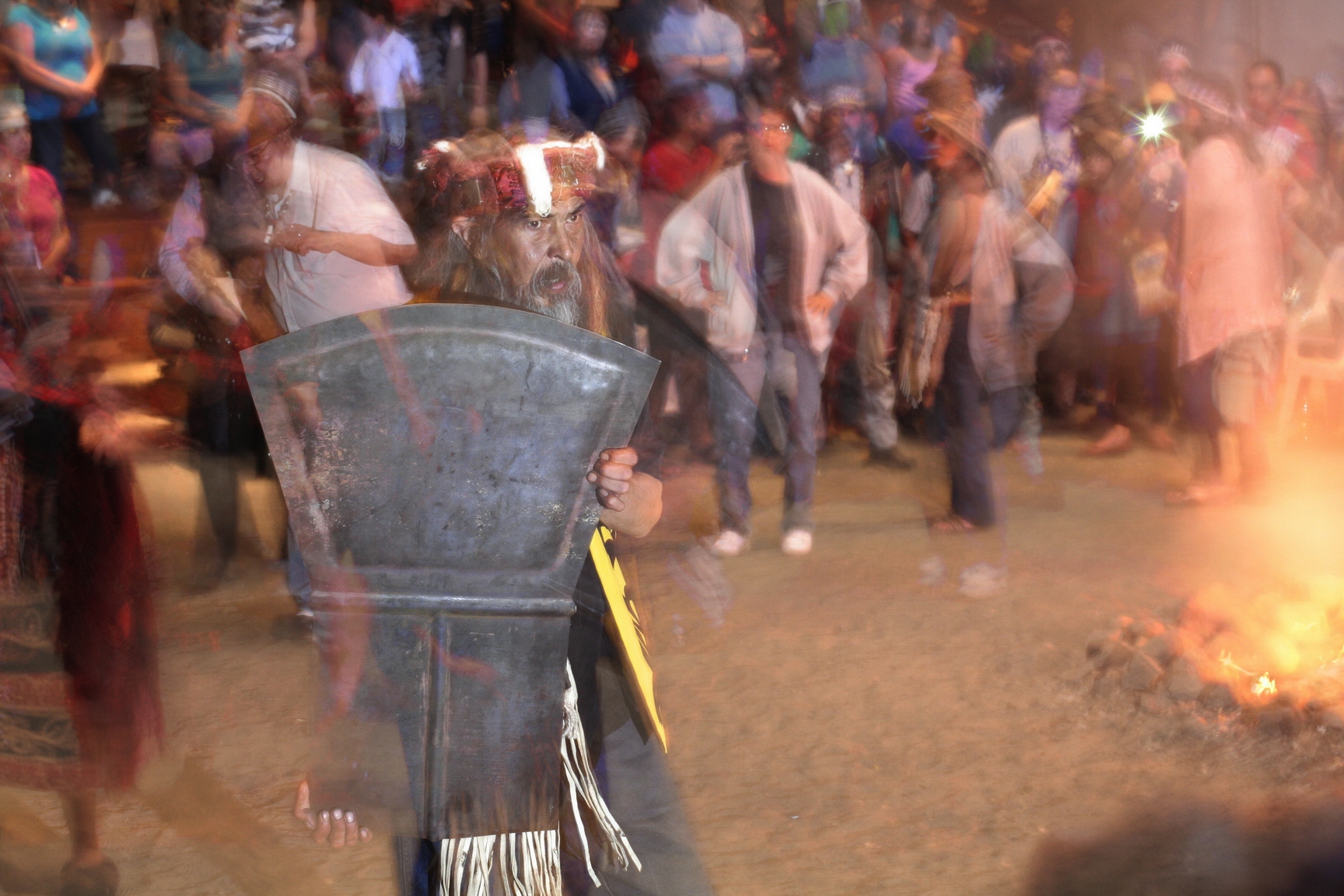
My colleague Alan Hunt, a Kwakwaka’wakw chief and carver, who worked with the late Beau Dick, will be performing an Atlakim Ceremony along with 12 members of the Alert Bay and Fort Rupert communities. The ceremony is a dance of the supernatural forest spirits usually performed during potlatches and winter dances. Traditionally, after four performances, the masks are ceremonially burned.

Steve Potlatch Fire 2
Burning Atlakim mask. Image courtesy of Steve Calvert.

In 2008 Beau Dick was the first artist in 50 years to perform this rite. He did so again in 2012. The set of Atlakim masks currenty on display in the Pine’s Eye exhibition at The Talbot Rice gallery, were intended to be burned at documenta14 in 2017.

Please do encourage your colleagues, friends and students to attend this event.

I wish I could be there too.

Steve Beau 1
Beau Dick carrying the potlatch copper Nunmgala during his Potlatch at ‘Namgis, Alert Bay, 2012. Image courtesy of Steve Calvert.

Mark Pilkington Talk (Stroud)

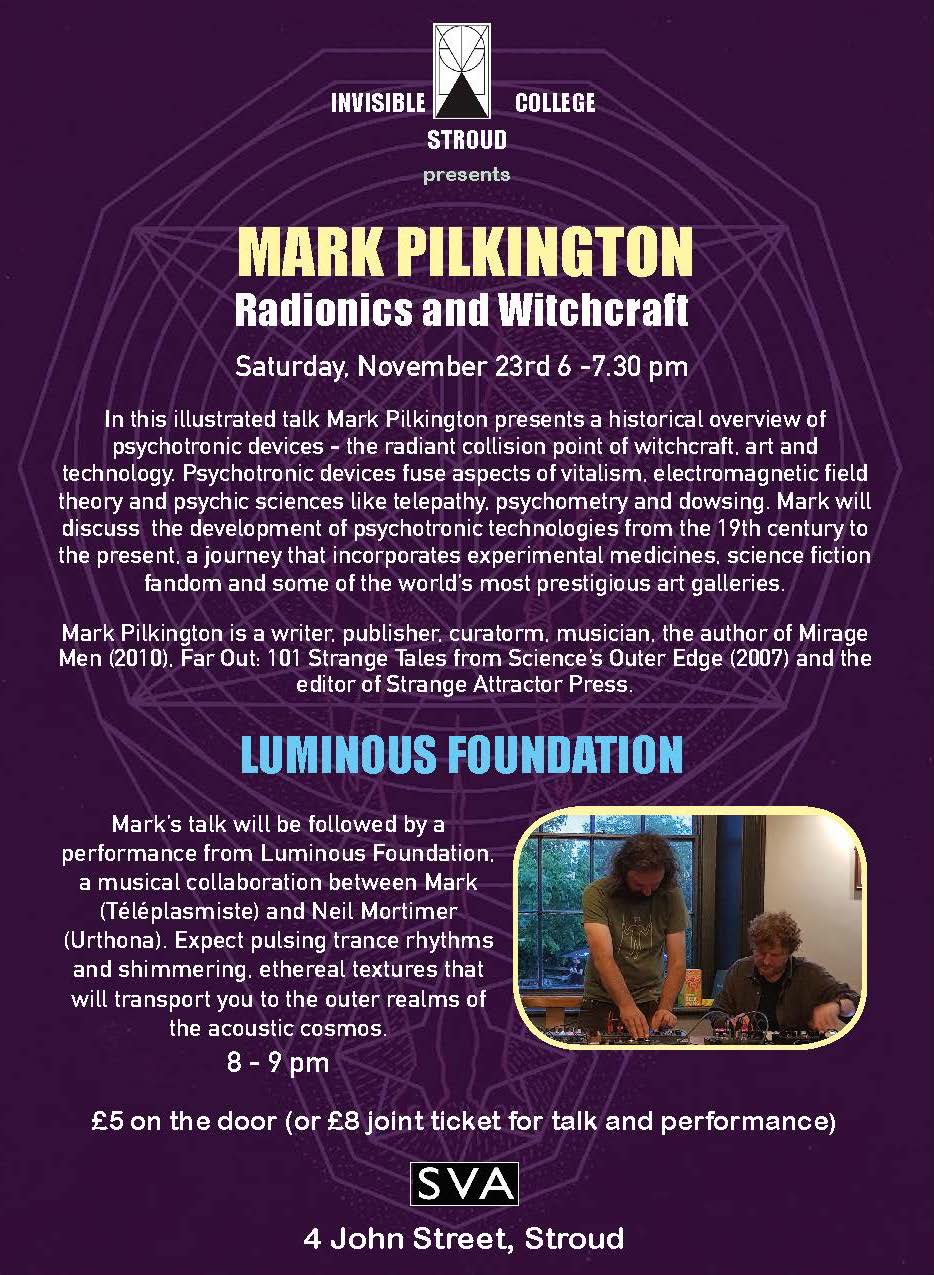
I will be hosting the fourth Art, Ecology and Science Fiction talk at SVA on Saturday November 23rd from 6 – 9 pm. Our guest will be the writer, publisher and musician Mark Pilkington, founder and editor of Strange Attractor press and the author of Mirage Men (2010). Mark will present an historical overview of psychotronic devices: “the radiant collision point of witchcraft, art and technology”.
Mark’s talk will be followed by a performance by Luminous Foundation, his collaboration with Urthona‘s Niel Mortimer.
 £5 on the door (or £8 for a joint ticket for the talk and performance).

Mark Pilkington Final

Vitalism and the Machine

Documentation of Dean Kenning‘s talk ‘Vitalism and the Machine’ at SVA on August 9th 2019, part of the Art, Ecology and Science Fiction series.

In the talk he discusses his kinetic sculpture works, social-body-mind maps, Arkady and Boris Strugatsky’s Roadside Picnic, Sci-Fi, Horror, the Soviet biochemist Alexander Oparin’s book What is Life?, Francois Jacob’s The Logic of Life, Descartes, animal automata, pain, Freud’s Beyond the Pleasure Principle, the death instinct, repetition compulsion, Jacques Lacan, Edgar Allan Poe’s The Facts in the Case of M. Valdemar and melt movies.