No One Understands You Like Me

Reading Jasun Horsley’s Seen and Not Seen

‘The present book will come out and, as with the last seven books I’ve published, it will be ignored by the mainstream press and change nothing or little for me on a surface level. It will cross the sky like a comet in the dead of night while the world sleeps, and only a handful of insomniacs will ever see it. That’s all it needs to be. There’s no need to climb the mountain. I need to be down in the dirt, where the stone is buried. I will find my home at Zero’.

Jasun Horsley, Seen and Not Seen: Confessions of a Movie Autist (2015)

Fortress of Solitude

I hadn’t thought about the book since I rested it on top of the rather limited fiction section of my library a few months ago. I’d picked it up at a give-away stall at the tube station I pass through when revisiting London. It was the cover that caught my eye: a swirling design of black graphic doodles on a parchment-coloured background. The author’s name rang a not-too-distant bell. Maybe someone a friend had recommended. The title cinched it: The Fortress of Solitude. It wasn’t going to be Celine or Kafka, but, given the endorsements on the back, it would likely be well-crafted, New York existentialism-lite in the mode of Paul Auster. Perfect for the tube.

The yellow post-it now poking from the book indicated that I’d made it to page 40 before parking it on the shelf. That’s probably about the average distance I get into a novel before my interest wanes. This is no criticism of Jonathan Lethem as a writer. It’s the form. The interwoven lives of semi-invented characters just doesn’t work for me and it’s a rare day that I make it to the end of any novel. I keep trying though. Most of my friends seem to like them very much and plough through them like butter. But when it comes to novels, I seem to have some form of literary ADHD. But who knew? Maybe this was an author whose novels I might have enjoyed till the end. The odd thing was it hadn’t occurred to me until this morning that the author of my random find was the same Jonathan Lethem who’d written the postscript for the book I had just finished: Jasun Horsley’s Seen and Not Seen: Confessions of a Movie Autist.

Jasun had contacted me by email two months previously, having heard a conversation between myself and Erik Davis, inviting me to discuss our shared interest in Video Nasties on his own podcast. I agreed, in principle. But first I wanted to familiarise myself with his writings. When I perused Horsley’s Auticulture website and listened to samples of his Liminalist podcast I was wary about entering into a public conversation with him. I could see that his interests gravitated around what might be called the paranoid end of the contemporary cultural spectrum: UFO’s, child abuse, false memories, satanism, alien abduction and mind control. It’s not that I have a personal aversion to discussing these things. On the contrary. But they are issues I have moved away from over the last few years for reasons of personal wellbeing and professional smarts.

Having fallen into teaching out of practical economic necessity in the 1990’s, it has taken many years to develop the kind of tactical intelligence that many of my colleagues in the education business seemed to have gleaned much earlier: keeping your head down, being ‘politic’ and not picking fights you can’t win. I was always a little too post-punk for the job. That’s all cool when you’re in your 20s and 30’s. And, if you play your cards right, even into your 40’s. But when you’re thirty years older than your students it just doesn’t cut it. To hold down a precarious academic gig in art schools these days it’s much better to be identified as the “theory guy” than the “horror guy”. I still think that’s the case, but I falter. Like many other “guys” I’d become mildly paranoid about how you’re identified in the eyes of your academic peers. In an increasingly polarised, reactionary and socially mediated milieu, any association with authors or ideas identified as “weird”, or worse “toxic”, can jeopardise what is already an increasingly precarious life-work situation. And even theory, once a credible thing to be associated with, in art schools at least, is now also viewed with suspicion.

Suffice to say, getting older has meant becoming more risk averse to engaging with anything that might tarnish my “profile” in the eyes of the academy (whatever that might be), or more importantly, in the social media chat of its customers. In fact, I’d become so concerned about my enthusiasm for ideas now considered beyond the pale of the tenured-academic, Guardian-reading consensus, that I’d taken to listening to Radio 4 – something I’ve never done before – as a form of auto-hypnotic behaviour modification that would make me more amenable to university interview panels.

The second, and more interesting reason for being cautious about Jasun’s work had to do with a sensitivity developed over many years investigating the relationship between psychopathology, paranoia and the occult, specifically to modes of thinking where rational-consensual thought folds into subjective fantasies that take on a life of their own. There is a kind of liminal zone, known well to those who have passed through it, between a reasonable person contemplating uncanny synchronicities with agnostic detachment and one who takes their amplification as sure proof that occult agents are running their lives. My immediate impression of Jasun was a person navigating this space with great analytical depth and sincerity. But I was unsure just how firmly in Chapel Perilous he was snared.

He offered to send me one of his books. I received Seen and Not Seen in the post a month later and had been reading it every morning since with my first cup of tea. What a joy!

Continue reading “No One Understands You Like Me”

AI/Midjourney Presentation

Below is the documentation of a presentation I gave at the ‘Challenges and Opportunities of Artificial Intelligence (AI) for Creative Educators’ event, the Art House, University of Worcester June 7th 2023, organised by my colleague Desdemona McCannon.

My talk has the rather formal title ‘Using Midjourney to Explore Relations Between Word and Image with Level 4 Fine Art Students’. Before I get to that, I take a detour through some of my PKD-related work.

Lecture at the Royal Academy Schools

I will be giving a lecture about my work at the Royal Academy Schools in London on Monday March 6th at 11.30. If you would like to attend please email me (j.cussans@gmail.com) and I’ll put you on the guest list. The lecture will be in three sections:

1. Ritual Practice : Veve Kunigundis

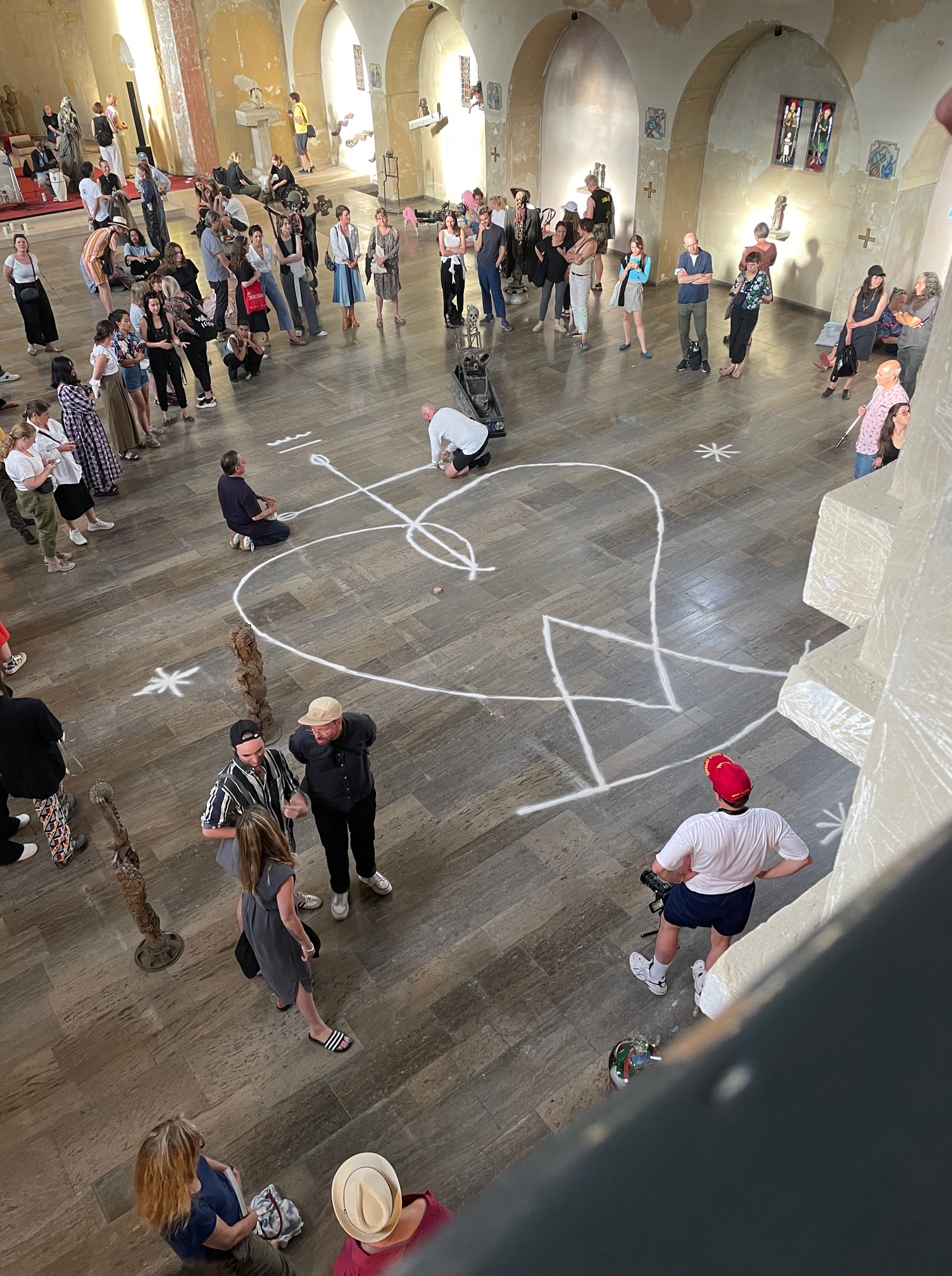
Focussing on the ritual drawings I make with Roberto N. Peyre, specifically Veve Kunigundis made during documenta15.

2. Drawing Analogies : Invisible Machines

Focussing on a chapter about ‘Psychoanalytic Imaginaries and Paranoid Critical Theory’ from the book on diagrams I’m writing with David Burrows, Dean Kenning and Mary Yacoob

3. Critical Arts : Health Humanities

Reframing critical and socially engaged arts practices from a mental health and wellbeing perspective

DIAGRAM AS THINKING MACHINE/ART AS METAPRACTICE

Below is an edited transcript of a talk I gave at the first DRUGG (Diagram Research, Use and Generation Group) gathering at University College London on July 14th and 15th 2012.

Fred Astaire and Hermes Pan, RKO Publicity Shot (1939)

Introduction

Diagrams play a fundamental role in the art of teaching, helping people do and understand things in ways that differ from and complement other teaching methods. Diagrams can be defined as visualisations of non-apparent systems, concepts, relationships, processes and ideas. They help students to recognise and understand parallels and structural correlations between things in the world; their constitutive natures; their internal structures; relationships; the systems of which they form a part; the processes they are involved with; their own physicality and subjectivity; the coming-into-being of all of these through time and space; and theoretical explanations for these becomings.

As visual and drawn objects with a pedagogical function, one might expect diagrams and diagramming to be established institutional objects and practices in art and design education. This is however rarely the case. Although diagrams and diagramming are often used in lectures, as tutorial aids and in student notebooks, they are seldom addressed in art education on their own terms. Having taught art theory and academic writing to art and design students for many years now, I have found them increasingly useful as teaching tools, particularly for helping students see and understand relationships between philosophical concepts, art theory, art making, thinking and writing.

Later I will try to construct a practical, systematic schematisation of diagrams. But for now I will simply include ‘diagrams’, ‘analogies’, ‘allegories’, ‘maps’, ‘plans’ ‘models’, ‘schema’, ‘pictograms’ and ‘technical illustrations’ in the category of things we might conveniently describe as diagrammatic. Generally they all combine, in an ostensibly unitary form, words, pictures, lines, figures, shapes, numerals, forms, axis, grids and tables. The diagrammatic in this sense is can be characterised by the following attributes: (1) graphic visualisation, (2) an economy of graphic means that minimise extraneous information (3) a high-level of representational and conceptual abstraction, (4) the representation of non-apparent systems and relations and (5) a generally didactic purpose. Later we will see that some of the key philosophers concerned with the diagrammatic depart significantly from this signifying, purposive and didactic schematisation.

Continue reading “DIAGRAM AS THINKING MACHINE/ART AS METAPRACTICE”

Veve Kunigundis at documenta15

Below is documentation of a work I made with Roberto N. Peyre during documenta fifteen in Kassel on June 17th 2022.

Completed Veve. Photo by Guillermina De Ferrari

Veves are ritual diagrams drawn in powder during Haitian Vodou ceremonies that represent the cosmic signatures of the loa, the pantheon of Vodou spirits. Veve Kunigundis was designed to represent the patroness of the church in which Atis Rezistans and colleagues from the Ghetto Biennale were exhibiting.

Atis Rezistans-Ghetto Biennale Installation. Photo Frank Sperling

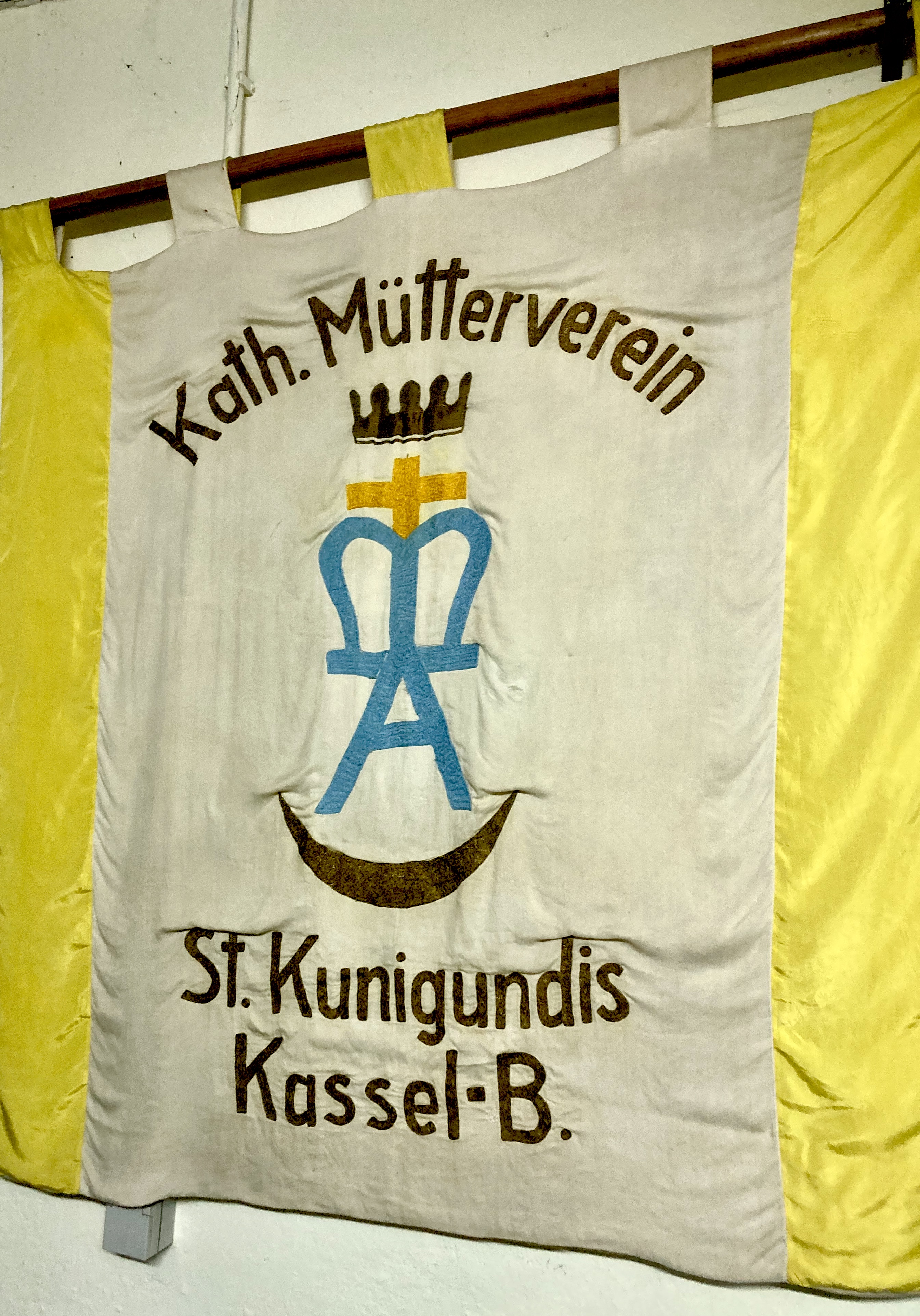
St Kunigundis, or Cunigunde of Luxembourg, was Empress of the Holy Roman Empire between 1014 and 1024. She was canonised in 1200. The church in Bettenhausen was completed in 1927 to serve the growing Roman Catholic community in Kassel. It was closed for renovations in 2019 when serious structural damage was found in the vaulted ceiling.

Banner for the Catholic Mothers Association at St Kunigundis Church

The design of the veve includes elements from the mythology of St Kunigundis: the red-hot ploughshare she walked on to prove her innocence after having been accused of adultery, the serpent contained in her chaste heart and the imperial crown. The decision to dedicate the drawing to the saint came after a man came into the building during preparations for the opening loudly defaming the installed work as blasphemous, sacrilegious and satanic.

The veve was drawn using quartz sand poured from glass bottles.

d15_St_Kunigundis_Atis_Rezistans_Ghetto_Biennale_Banbha_Mooira_Kassel_2022_Foto_Frank_Sperling

When the drawing was completed we created a candle-lined walkway between the alter and the veve in preparation for the second part of the ceremony; Jann Pase’l Pase & Mache Nap Mache (Walk the Walk and Talk the Talk), the re-creation of a work first made by Roberto in collaboration with Jean-Louis Huhta and Jean Claude Saintillus at the Ghetto Biennale in 2013.

Veve and candles. Photo Frank Sperling
Jean Louis Huhta (aka Dungeon Acid) preparing for Jann Pase’l Pase & Mache Nap Mache. Photo FrankSperling
Completed Veve: Photo courtesy Pedro Lasch

Beginning with myself and Roberto, artists from Atis Rezistans, the Ghetto Biennale and audience members paraded along the ‘catwalk’ breaking up the veve.

Roberto walking the walk. Photo Frank Sperling
The Ghetto Biennale curatorial team walking the walk (Left to Right: Evel Romain, Cat Barich, Liz Woodroffe, Andre Eugene, Leah Gordon). Photo Frank Sperling
GB artist Simon Benjamin and GB curator Liz Woodroffe walking the walk. Photo Frank Sperling
Participating artist Demar Brackenridge walking the walk: Photo: Frank Sperling

Here is the official video made by the documenta team. As you can see, it turned into a party.

And this is what was left in the morning.

Obliterated veve (the morning after)

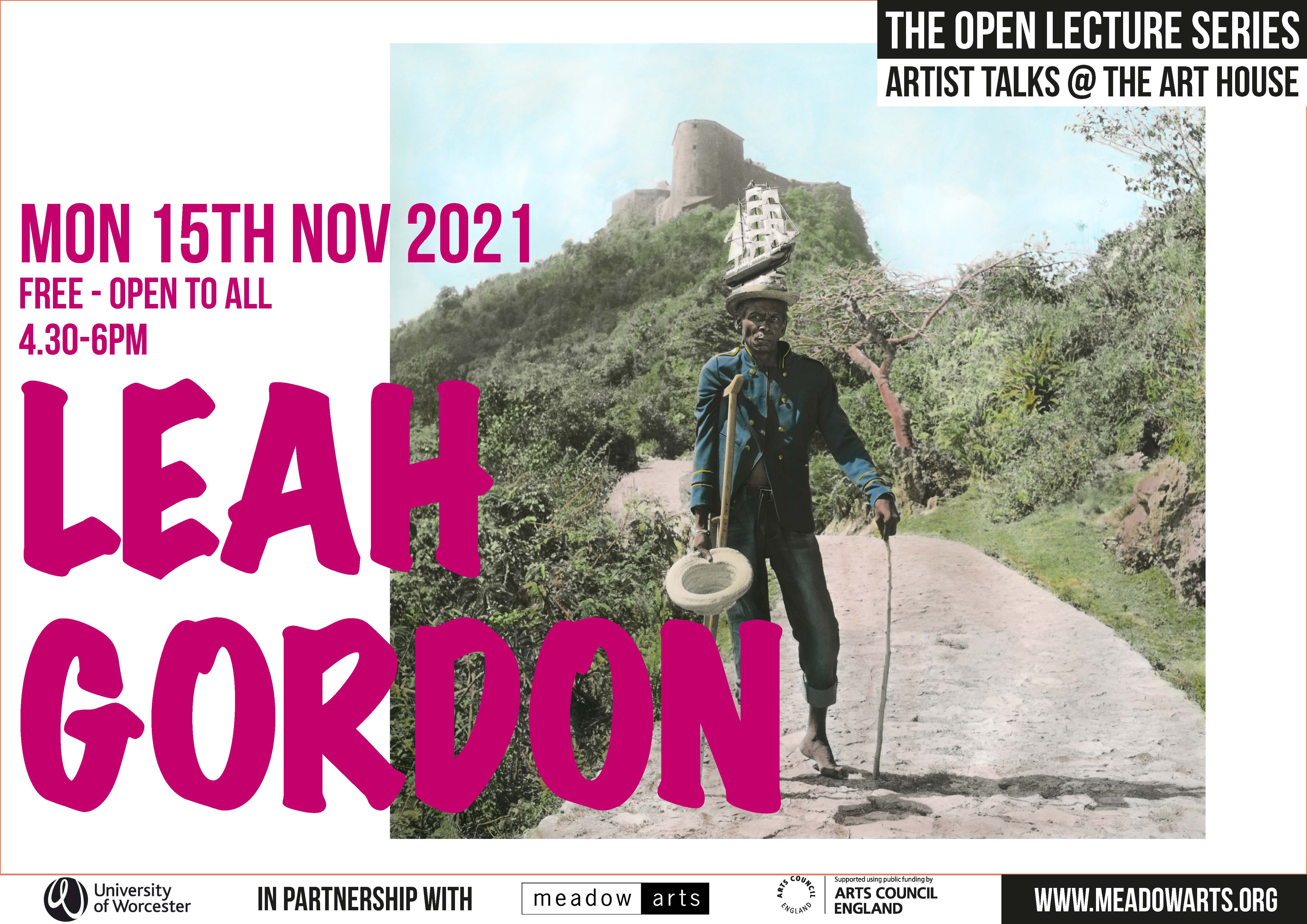
Leah Gordon Artist Talk (Recording)

Here’s a link to the recording of Leah Gordon’s artist talk which I hosted at the Art House in Worcester in November. For those of you who don’t know Leah’s work, she is the co-curator of the Ghetto Biennale and an artist, photographer and writer with an impressive list of works, curated exhibitions, and books on her CV. She is currently in Kassel working with Atis-Rezistans on a Ghetto Biennale on-site project for documenta 15.

In Conversation with Logan Dandridge

I will be in conversation with the artist Logan Dandridge this Saturday at the Bawden Room, Jesus College, Cambridge between 6 and 9 pm. Tickets are free and you can book them here.

Logan is a filmmaker from Richmond, Virginia, USA and currently the Cavendish Arts Science Fellow at Girton College. Logan’s experimental approach to moving-image work connects Black experiences and the evanescence of memory with spoken word, sound and rhythm.  We will be discussing our shared interests in Black music, Afrofuturism, deep space, sci-fi, spiritualism, ritual, and communion in music and dance via Bill Gunn’s film Ganja and Hess, Aretha Franklin and Kendrick Lamar.