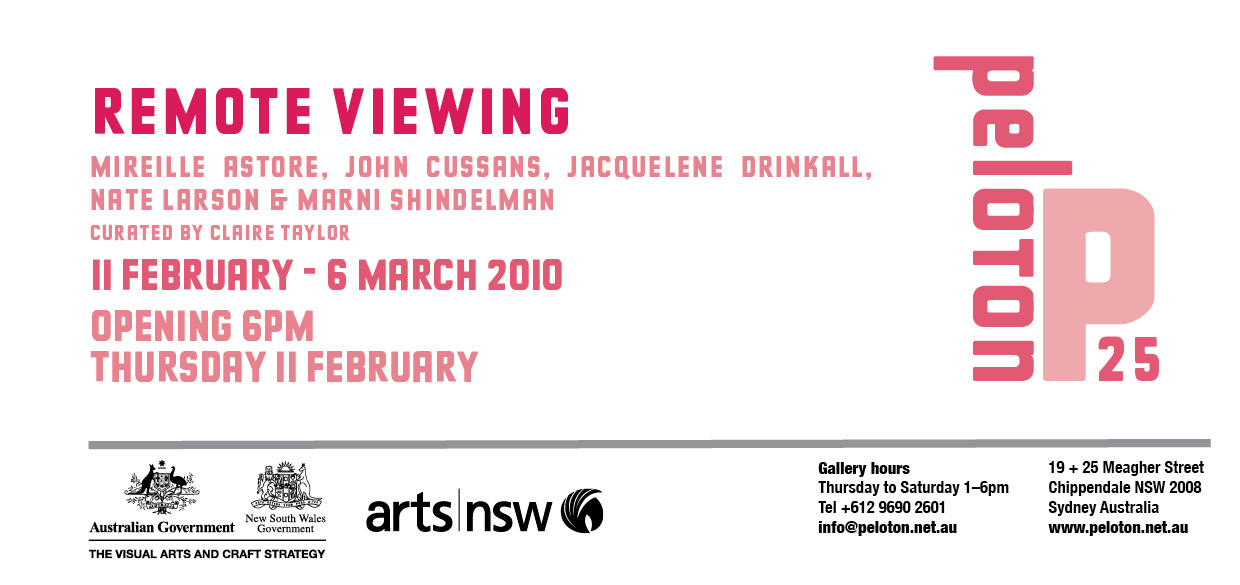
If anyone happens to know anyone in Sidney they might want to go to this show in which I’m showing the Invisible Mirrors film about the ceremonial boar.


John Cussans' blog
If anyone happens to know anyone in Sidney they might want to go to this show in which I’m showing the Invisible Mirrors film about the ceremonial boar.
Update from Emergency Meeting at Gasworks, Sunday Jan 24th
Following last week’s meeting to coordinate solidarity action with Haiti we established a working group called the ‘Haiti-London Konbit’. We have set up a list-server with Indymedia where people can post information about upcoming events. Just add your email address and any mails you send will be distributed to the other members of the the group.
Konbit is a traditional form of cooperative communal labour in Haiti, whereby the able-bodied folk of a locality help each other prepare their fields. Haitian peasants, as a rule, have a small plot of land to themselves that they use for subsistence (they feed themselves and their family from it). Otherwise, the bulk of their work is sharecropping, a form of feudal slavery, whereby they work for a landlord who takes the lion’s share of their produce. Konbit involves weeding, stone removal, planting, sometimes even the harvest. It is a time for solidarity and cooperation in the face of adversity and usually involves a feast offered up by the recipient of the help (thanks Andrew Taylor from the Haiti Support Group for this definition).
Most of the people present at the Gasworks meeting agreed that there is a widespread lack of awareness about the basic facts of Haitian history. Even people with an interest in the country are unaware of how and why Haiti became such an economically impoverished nation. The next post on the blog will be a very brief history of Haiti and its Debt. In advance of that post here is something an article on the issue of Haiti’s debt from the PAPDA (Haitian Advocacy Platform for Alternative Development) website and Hilary Beckle’s article The Hate and the Quake.
We would like to develop a Web 2.0 video version of the story of Haiti’s debt (possibly in collaboration with artists from the Grand Rue) to circulate on the internet. We will be discussing the logistics of this at the Free School event.
During the meeting at Gasworks we began a discussion about the legitimacy of the language of ‘debt’ in the context of Haiti and the racist misrepresentations of post-earthquake Haiti being on the edge of anarchy. I expect there will be more to discuss on these issues at a later date. But in the meantime here is an excellent and well-hyperlinked article on language of ‘looting’ in the journalistic response to the earthquake in Haiti by Rebecca Solnit.
There seemed to be strong support for the idea that what we are witnessing in Haiti is an example of ‘disaster capitalism’ as defined by Naomi Klein, and that the media focus on ‘looters’ and ‘rioters’ was a significant component the ideological apparatus being used to justify the presence of tens of thousands of US military personnel on the island. John Pilger has written an incisive riposte to the militarization of the aid effort in Haiti and parallel media reports about ‘criminal mayhem’ for the New Statesman. Peter Hallward’s recent article for Monthly Review is also very good in this context, arguing that the current US presence in Haiti amounts to a third military occupation.
Update on the best organizations to donate money too
Although some aid is now starting to get through to communities in Haiti, more than three weeks into the massive aid program there is still a severe bottleneck on the resources and the majority of the population have still seen seen no assistance. Leah Gordon has reported that an unofficial zoning system has been put in place by the military authorities divided into green zones, where relief can pass freely, and red zones which have restrictions placed on them. The Grand Rue area for instance is in a red zone, as are many of the poorer neighborhoods in Port-au-Prince. Democracy Now addressed the problems of aid distribution to the red zones here.
Flavia Cherry, chair of the Caribbean Association for Feminist Research and Action (CAFRA) has reported that the major aid agencies have done little to prioritize aid for the most needy member of the population and that it is obvious that the agencies are unable to handle the scale of the problem on the ground there. She questions why Caribbean governments are not being allowed to play a role in the operation despite many willing volunteers who can speak Creole and are ready to take aid directly to the most needy populations.
Ryan McCrory, Co-Director Haitian Sustainable Development Found, reported his recent experiences with the aid distribution program to the HSG. The large NGO’s require communities to fill out a 100 question form in order to receive aid. These forms can take as long as a week to complete. Of particular difficulty is explaining directions to locations in a city reduced to rubble by the earthquake. The Haitian government is being entirely bypassed in this operation and small organizations have completely given up trying to work with larger NGO’s and the UN because there has still been no sign of their goods being released. Instead they are traveling to the Dominican Republic to buy food and medical provisions..
I have been in regular email contact with Charles Arthur of the Haiti Support Group. The following is a summary of that discussion.
The Haiti Support Group (HSG) has circulated an important statement from the Coordinating Committee of Progressive Organizations presenting an overview of the current situation which can be found on Norman Girvan’s website.
Following this statement the HSG are now concerned that such is the international response to the many Haiti emergency appeals – i.e. so much money has been donated – that those organisations running the appeals will be in a position where they cannot distribute/use the money quickly or in a way that reaches the more marginalised people/organisations. They are concerned that many organisations in Haiti that are working with marginalised people but don’t have good international connections are not going to get any financial assistance. In this context you might consider making your funds available to the HSG for it to distribute to less well-known but equally deserving grassroots organisations. The HSG would match any tax relief that you would have got by donating to the big humanitarian agencies.
The best way to send money to the HSG is by direct bank-bank transfer, details as follows:
Payee name: Haiti Support Campaign
Payee account number: 6 1 7 2 0 9 4 1
Payee sort code: 6 0 – 0 3 – 3 6
Alternatively you can send a cheque to;
Haiti Support Group
c/o Leah Gordon
10 Swingfield House
Templecombe Road
London E9 7LX
The entirety of donations will be divided in three equal parts and sent as soon as possible to the following:
KOFAVIV is a women’s organisation that for many years has been working with women in the poorest and most marginalised communities in Port-au-Prince. It provides a space for women to meet, medical care for victims of rape, sexual violence, and other violence, advice on legal issues, and many other forms of practical and moral support to women who otherwise would get no help at all. It was the only organisation in Haiti that publicly denounced the rape and sexual violence committed by the gangs that controlled various shanty-towns in Port-au-Prince in the 2004-6 period. KOFAVIV lost its office in the quake. Many core members lost their homes and are now living on under plastic sheets in the main square in the capital. From there, they are trying to continue to provide help to other women.
Batay Ouvriye is a workers’ organisation which since 1995 has been helping factory and plantation workers to organise themselves to win improvements in wages and working conditions. It is one of the few active and effective workers organisations in the country. In Port-au-Prince the core members are providing relief and assistance to the best that their limited resources allow at the Batay Ouvriye centre in Delmas 16. Workers who have lost everything – their jobs, their homes, their spouses and children, and families which have lost their ‘bread-winnner’ are getting help from Batay Ouvriye but the organisation desperately needs financial assistance. It has a few links with organisations abroad but not with any which have large resources to be able to make sizeable donations.
The PAPDA/POHDH plus 4 organisations are some of the most effective Haitian progressive organisations working with the majority population on issues of participatory democracy, the economy, human rights, education, communications, etc. The two platforms and four organisations – many of which lost their offices in the quake – have set up a coordinating committee to pool resources and organise joint responses to the disaster. They have opened a centre in Canape Vert to provide medical and material assistance to survivors. They plan to open more of these centres in areas of the city that are more or less ignored by the large humanitarian agencies.
PAPDA has set up a bank account for the purpose of directing material contributions to the organizations it works with:
PAPDA BANK ACCOUNT FOR CHANNELING SOLIDARITY SUPPORT:
Account Name: Camille Chalmers and Marc-Arthur Fils-Aimé
Account Number: 130-1012-457066 (checking account)
Bank Name: Unibank SA, Port au Prince, Haiti
Swift code: UBNKHTPP
UniBank has many accounts to receive money in Euros or U.S. dollars:
1) At Wachovia bank in New York (BIC Code: PNBPUS3NNYC. ABA / Routing: 026005092). The account of the UniBank there is: 2000192002189
2) At Société Générale, 1221 Avenue of the Americas New York (BIC Code: SOGEUS33. ABA / Routing: 026004226). The account of the UniBank there is: 194,980
3) At Société Générale, Paris la Defense Cedex 92,972 France (BIC Code: SOGEFRPP. Count UniBank there in Euro: 003-01-50607-0 IBAN: Fr 7630003 06990 00301506070 53)
4) In Bank of America, London England (BIC code: BOFAGB22. UniBank Count in euro: 6008 23805023 IBAN: GB33 BOFA 1650 5023 8050 23. In sterling account: 6008 23805015 IBAN: GB33 BOFA 1650 5023 8050 15
5) Banque Nationale du Canada International Commercial Operations, 1010 Rue de la Gauchetière Ouest, Suite 750 Montreal PQ Canada H3B 5K7, BIC Code: BNDCCAMM. Count UniBank there: 097608-236-001-001-01 (Dollars canadieneses) 097608-240-002-001-01 (USD)
6) In Banque Royale du Canada, 180 Wellington Street West Toronto, Ontario M5J 1J1 Canada – BIC Code: ROYCCAT2. Account UniBank d ela there: 09591-406-583-5 (USD) / 09591-390-111-3 ($ CAD)
I will be posting updated information and commentary about the unfolding situation in Haiti here.
We have put out a call to groups, collectives and individuals to attend an emergency meeting to discuss collective action in response to the situation in Haiti. Please send a representative of your group if you can, or email us so we can keep you informed of further action / meetings.
Sunday 24 January 2009
2.00 – 4.00 pm at the Do you remember Olive Morris? exhibition that has meeting space available.
Gasworks, 155 Vauxhall Street, London SE11 5RH (tube: Oval / Stockwell)
I am currently working on a brief historical overview of the situation in Haiti and information about how best to get charity to the right places most effectively and most immediately. I should have this done for the meeting on Sunday and will post it here.
I’ve also uploaded some video footage from the Ghetto Biennale here. It shows Grand Rue artist Alex Louis interviewing the toy Tap Tap makers during the opening event.
I have also posted some images from the Ghetto Biennalehere.
And I just uploaded a clip of Reggie Jean Francois here telling the story of how Sri Lankan troops in the UN mission to Haiti performed a ceremonial ritual on the sculpture of a boar in Port-au-Prince in 2004.
Please feel free to use and circulate.
Donations to Organizations active on the ground in Haiti
Given that the social sector of Haiti is now run almost entirely by NGO’s these are the organizations that are likely to be delivering aid and assistance on the ground there. However the massive involvement of international NGO’s has the long term effect of undermining Haiti’s powers of democratic self-determination.
For people wishing to get their donations directly to the communities in most urgent need I suggest the following organizations, most of which are run largely by Haitians in Haiti:
1)PAPAZA
PAZAPA staff, who survived the quake, indicate that there is an immediate need for food, clean drinking water, shelter and medical care. They describe virtually no distribution of emergency food (with much of the disaster relief efforts centred in Port au Prince) and have stated that the primary work of emergency relief agencies in that community has focused on search and rescue. The price of food is rising and water and fuel is becoming dangerously scarce. They need our help with funds to immediately purchase essential food supplies such as rice, beans and oil, that can be distributed to the centre’s children and families most effected by the quake. PAZAPA staff are working, despite suffering their own losses, to locate and assess the needs of the centre’s children who will be terribly affected by this tragedy. For more information about the centre, link to a recent video , http://www.youtube.com/watch?v=5OKK1T-zgdA.
Konbit Pou Ayiti/KONPAY (Working Together for Haiti) strengthens existing organizations, builds national networks, creates relationships between individuals and organizations in the U.S. and Haiti, and and supports collaboration and the sharing of technology and expertise. KONPAY focuses on Haitian solutions to environmental, social and economic problems and provides training and funding to grassroots and community-based projects.
Haiti-Earthquake-Emergency-Relief-Campaign
3) Honor and Respect for Bel Air, a big community-based network in Port-au-Prince, and Coordination Régionale des Organisations de Sud-Est (CROSE), which brings together some of the most active community groups in the south (via Avaaz.org)
The Lambi Fund’s mission is to assist the popular, democratic movement in Haiti. Its goal is to help strengthen civil society as a necessary foundation of democracy and development. The fund channels financial and other resources to community-based organizations that promote the social and economic empowerment of the Haitian people.
5) Haitian Platform to Advocate Alternative Development (PAPDA)
PAPDA is a coalition of nine Haitian popular and non-governmental organizations which work with the Haitian popular movement to develop alternatives to the neo-liberal model of economic globalization. When the Haitian government moved to privatize certain industries, PAPDA worked with the unions and the business community to create strategies that would improve production and minimize cost without privatization.
6) The Haiti Emergency Relief Fund
7)FONKOZE
Fonkoze is Haiti’s alternative bank for the organized poor. In fact, it is a family of three institutions working together shoulder-to-shoulder towards a single compelling mission: building the economic foundations for democracy in Haiti by providing the rural poor with the tools they need to lift themselves out of poverty. This mission is reflected in our name, Fonkoze, which is an acronym for the Haitian Creole phrase “Fondasyon Kole Zepòl” meaning “Shoulder-to-Shoulder Foundation.”
I await news from Leah Gordon who is now in Port-au-Prince about what is the most effective way to get aid working on the ground.
According to a CNN report from Sunday one of the few working hospitals in Port-au-Prince is La Paz hospital.
This hospital is being run by Cuban medics supporting the strong argument for more Cuban-US cooperation in the aid mission.
Here is a video report from MediaHacker Ansel on the ground in Haiti the day after the quake in which local citizens express their anger at the absence of assistance from either UN or US forces.
Activists and citizens both in and outside of Haiti are concerned with what they see as a lack of response by the UN authorities in Haiti and by recurrent stories of immanent violence on the part of the Haitian people which we fear may be used to justify violent intervention by both the UN and US forces against the Haitian people. Articles like Tim Padgett’s ‘Will Criminal Gangs Take Control in Haiti’s Chaos‘ and Mark Lander’s ‘Clinton, in Visit to Haiti, Brings Aid and Promises Support‘ set the tone for this kind of ideological scare-mongering. Lander warns that “As Haitian and international officials try to coordinate an effective relief response to what is probably the worst disaster to ever hit the western hemisphere’s poorest country, they’ll need to be mindful of the human rats that come out of the capital’s woodwork at times like these”.
He goes on to say that “unless the international community can exert some semblance of street-level law enforcement in the coming days and weeks, gangs are likely to lay down the law in its place”.
Outside the mainstream media reports from the ground tell a very different story, such as this one from Dave Belle, director of the Cine Instute there.
Regarding the historical politics of debt and aid in Haiti this article by Richard Kimin The Nation is one of the most thorough and informative, exposing precisely that ‘history’ which Bill Clinton, in his speech accepting the job of coordinating the US aid mission in Haiti, said that Haiti was on the verge of ‘escaping’.
Clinton’s complicity in UN Human Rights abuses in Haiti is discussed here.
In the recent post concerning the ‘Critique of the Biennale Circuit’ I described the experience of visiting the NS Harsha installation ‘Nations’ as like a contemporary shopping experience. Then I came across this:

Appropriately enough the All Saints Spitalfields store was one of the East End Fashion Emporiums in that the Iniva gallery initially reminded me of.
‘Just when the class structure is being rigidified and polarized, when the hypermobility of capital gives the transnational bourgeoisie an unprecedented capacity for domination, when the governing elites of all the great powers dismantle in concert the social safety nets set up in the course of a century of labor struggles, and when forms of poverty reminiscent of the nineteenth century resurge and spread, they converse on the “fragmented society,” “ethnicity,” “conviviality,” and “difference.” Where one would need an unflinching historical and materialist analysis, they offer us a soft culturalism wholly absorbed by the narcissistic preoccupations of the moment.’ – Loïc Waquant
Last week saw the first of the General Theory Forum lectures at Chelsea. After introducing students to the formal stuff, I did a small presentation about ‘Theory’ and ‘Criticality’. One of the set texts for this presentation was Loïc Wacquant’s essay ‘Critical Thought as Solvent of Doxa’ which gives a useful overview of the current state of critical thought in Anglo-American educational institutions. Wacquant’s essay introduces the two major traditions informing contemporary critical thought in a clear and comprehensible fashion. The first, derived from the work of Kant, is concerned with the validity and value of knowledge categories and faculties. He calls this type of critique epistemological. The second he associates with the Marxian tradition of critical thought which ‘trains the weapons of reason at socio-historical reality and sets itself the task of bringing to light the hidden forms of domination and exploitation which shape it’. This tradition he calls social.
It is a useful and straightforward distinction that has helped me address my troubled thoughts on the notion of a ‘Critique of the Biennale Circuit’. But before I expand upon these ideas I think we need to add a third type of critique, perhaps not so familiar or relevant for colleagues working in the social sciences and humanities, but one which we spend a great deal of time thinking and talking about in art schools. That is aesthetic critique.
Aesthetic critique exists in an intermediary place between the epistemological and the social. On the one hand art and design practices are at times assumed to be engaged in the production and disputation of knowledge and truth (familiar to anyone involved in postgraduate art education in the UK and its struggle to legitimate artistic practices as ‘Research’) and at other times they are approached as practices with a clear social value and function (familiar for those arguing for socially engaged and politically conscious art and design practices). Between these two critical positions there are the questions of taste, beauty and the autonomy-ontology of Art (with a capital ‘A’) associated with aesthetics.
Never having been to a biennale I’m in no legitimate position to critique the circuit. So what I have to offer here are more practical suggestions and observations about critique in general and its relationship to the arts in a globalized cultural context.
The three types of critique defined above are often inter-related, particularly in the context of contemporary art criticism. A ‘Critique of the Biennale Circuit’ would benefit from being precise about what kind of critiques are being applied to it. Before we can effectively criticize a thing we need to agree on what it is and what it does. So we need to be precise about what is meant by the ‘Biennale Circuit’, what kind of ‘object’ it is, its temporal and spatial parameters, how it came into being and what it is intended to do. Consensus about such things is rare in the world of contemporary art where values and views are often conflicted and divergent. But for critique to have any practical value (i.e. to have the intention of improving the thing criticized) then agreements on definitions of objects and terms is essential.
As we will see this affirmation of the generally practical nature of critique is more difficult to maintain when addressing a work of art than it is when addressing something like a government policy. This has a lot to do with the deeply formative 18th century philosophical tradition of approaching Fine Art as something beyond Reason and without practical purpose (what Kant referred to as the ‘disinterest’ of the aesthetic attitude) and it can lead us into some very tangled conceptual territories, as we will see. One of the difficulties I see in advance in a critique of the Biennale circuit is how to distinguish between what a Biennale should do and what the art that constitutes it should do? How are these two things related? Do we need different evaluative criteria for these two types of things?
In order to explore the inter-relationship of the different critiques, to begin a discussion about of what is meant by the ‘Biennale Circuit’ and to situate some of the theoretical issues we are likely to encounter in this context, I’d like to briefly discuss an artwork currently on display at the Iniva gallery in London: an installation called ‘Nations’ by NS Harsha.
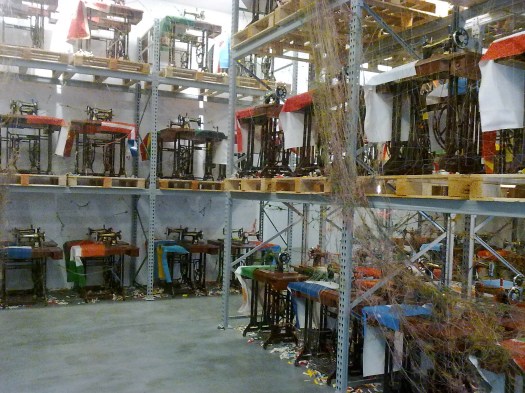
Although this exhibition is not formerly part of a biennale, the work was first shown at the Sharjah Bienniale in the United Arab Emirates in 2008. The same year Harsha was awarded the £40,000 Artes Mundi Prize, an international arts prize funded by Bank of America/Merrill Lynch. I also felt that the work has relevance for two of the projects which will be part of the Ghetto Biennale: Hanna Rose Shell’ film about the second hand (Pepe) clothes industry in Haiti and Carole Frances Lung’s ‘Made in Haiti’ project.
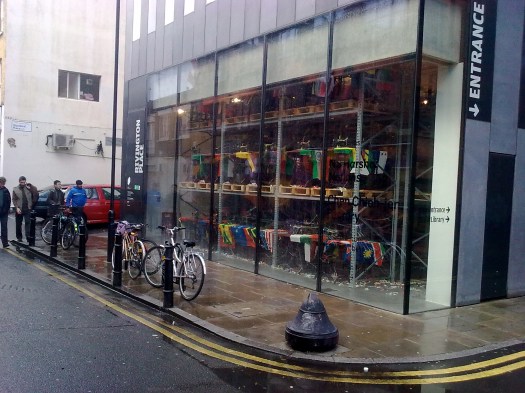
The Iniva building in which ‘Nations’ is installed is situated in the epicentre of a particularly fashionable part of London that my good friends disdainfully refer to as Hoxditch (a combination of Hoxton and Shoreditch). The area became very fashionable in the early 1990’s largely as a consequence of the presence of YBA (Young British Artists) who had moved in to the area because of the cheap studio space there. Despite predictions the area continues to be regarded as one of the most culturally hip and ‘cutting-edge’ in London. ‘Nations’ is installed in a glass-fronted gallery that faces onto Rivington Place, a relatively quiet connecting road between two major Hoxditch arteries. If you didn’t know it was a gallery you could easily mistake it for one of the retro-fashion or furniture emporiums in the area (or, perhaps, a fixed-wheel bicycle shop).
I mention this simply to underline the fact that where art takes place can be subject to critique as much as the work itself and that one of the simplest ways to move from a purely formal level of aesthetic critique to a social one is to take in to account the context in which the art takes place. In my experience the tendency to approach artworks as hermetically sealed aesthetic objects, ‘properly’ evaluated in purely formal terms, usually functions to deny the obvious class, cultural and economic operations that put the work in place. In this sense aesthetic formalism is the most common alibi for the de-politicization and de-historicization of critique. It is also often the alibi for the mysteriously inflated market value of some contemporary art, where it serves a similar function.
The recent history of Hoxditch is exemplary of the ways in which contemporary art, if we want to approach it from a critical social perspective, should not be separated from the broader economic and political contexts in which it occurs. In terms of the changing patterns of gentrification in the modern world-city, the culture of contemporary art is often at the vanguard of ‘urban development’ or ‘cultural regeneration’ programs and artists, in their quest for cheap living and studio spaces, operate as property pioneers in the cultural renaissance of poor and under-valued areas of the city. This is something we should think about in terms of the Grand Rue area of Port-au-Prince. Why this location? What is the cultural and social history of this area? Why has it generated a local art movement? What do we expect the Ghetto Biennale to effect in this location? How different is this location from the kinds of places Biennales ordinarily take place?
Before giving an aesthetic evaluation of ‘Nations’ itself I think it’s important to note that the general, default setting of much everyday art criticism tends to adopt a ‘personal’ orientation. I think this has allowed ‘political correctness’ to function in the art world as a cloak for liberal, bourgeois normativity. In these contexts it often operates to protect the work from effective social and political criticism. It is as if the 19th Century fantasy of a pure aesthetic realm of critique, some ‘higher level’ of taste and sensibility peculiar to the refined individual, has assimilated ‘identity politics’ which now functions to protect the art, artist and their administrators from the ‘personal attacks’ that a broader socio-cultural critique might ‘inappropriately’ implicate them in.
I wrote in the last post about a certain dominant cultural ambience that pervades academic and art events in London, so I don’t want to talk too much about it here. But I do think it is important to extend critique not only to the situated context in which art and theory take place, but also the habitual patterns, behaviours and cultural mores according to which it is administered. In terms of academic traditions we could define this area of analysis as one where classical aesthetic theory (concerned primarily with the work of art in its institutionally defined sense) coincides with cultural studies (concerned with culture in the wider sense). I have written elsewhere and spoken at length in my lectures about the need to extend aesthetic awareness and critique beyond the perimeters of the traditional art object and deep into the fabric of everyday culture and behaviours in order to demystify the socially obfuscating myth of the ‘sacred’ art object and to demonstrate the subjectively embodied nature of aesthetics in order to implicate that critique in everyday ethical practice. Contemporary art is administered in very particular ways, and these modes of administration have distinct aesthetic and political qualities in themselves. The sense of ritual politeness that characterizes inter-personal behaviour in established, institutional art worlds is an aesthetic object in itself and should be as open to critique as the works themselves.
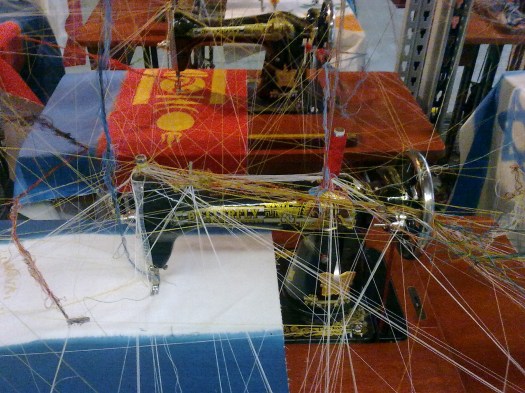
‘Nations’ is made up of 192 sewing machines, installed in such a way as to the give the impression of a multi-tiered sweatshop. Each sewing machine is accompanied by a printed flag representing a member state of the United Nations. The tangled threads from each machine binds the network of machines together and fragments of multi-coloured cloth litter the floor around the machines like confetti. Walking around it made me feel like I was in a showroom and I thought, as I often do in such places, about the similarity of a contemporary art experience and a contemporary shopping experience. On closer inspection I was struck by the fact that the flags were printed rather than sewn. This seemed to jar with the general message about the ‘inter-wovenness’ of the global ‘rag trade’ that the worked seemed speaking about in a rather literal way. If I understood the intention of the work correctly, machine-sewing the flags together would have made it a more aesthetically interesting and impressive work. I suspected that it was probably too technically difficult to do this and that printing the flags was a straightforwardly expedient creative decision. Then again, perhaps the printed nature of the flags was intended to be allegorical of a deeper level of national ‘disconnection’ amongst the ostensibly ‘united’ nations. But that idea seemed a bit naff, whether it was my interpretation or Harshas’ intention.
For me the work in the end is rather over-blown and uninspiring. Its proportion was too excessive and grandiose for the simple, self-evident message it seemed, ultimately, to be communicating. And there was little about its formal aesthetic construction that intrigued, surprised or excited me. It looked like a typical piece of contemporary installation art that one regularly encounters in galleries and museums of a certain form, scale and stature.
What interested me most were the household sewing machines themselves, their pristine uniformity, their English name, their antiquated appearance and their place of origin. (The ‘Butterfly’ sewing machines are made in Vietnam for the Chinese company Jinyun Shenma). I was reminded of the art historical legacy of the found-object and how this might be re-thought in the context of multiple-asynchronous ‘modernities’ and widespread (global) awareness of the integrated nature of the contemporary capitalist production processes. I thought of Sadie Plant’s Zero’s and Ones: Digital Women and The New Technoculture and how superficial the piece seemed to me in light of this kind of cultural history and theory; of the absence of any reference to the gender or class character of sweatshop labour; or the machinic geneology of sewing machines and computers which have fashioned the digital integration of the network society. And somewhere in the back of my mind I saw an umbrella and a sewing machine on an operating table.
I’m no art critic, and have no intention of becoming one. No doubt my sensitivities towards the work might be more refined if I took art criticism as my vocation. What interests me more is how the work communicates in its broader cultural context, how it is ‘discoursed’ within the wider network of theory and politics and the contradictions that abound around it.
Information about ‘Nations’ on the Iniva website informs us that the artist – who ordinarily works in traditional Indian miniatures – was inspired to make the work after the shock of visiting a small-scale textile factory in his native country (I was later told that he had visited the factory in order to make studies for a painting). We read how he “personally experienced the realities of ‘human labour’” which brought to his attention the fact that “hierarchies and exploitation are part of today’s global economic order” (Iniva website)
I suppose if one had never been in a factory before then the installation might evoke similar feelings of claustrophobia and an awareness of the exploitative indifference of mass manufacturing processes that Harsha himself claims to have experienced. Perhaps the similarities between art galleries and fashion emporiums were being intentionally evoked here, in order to draw our attention to the interconnectedness of these two fields of contemporary cultural activity. But I wonder who, whether they have visited a factory or not, would be unaware of the global inequalities of labour which underpin the contemporary retail fashion system? And why would we need contemporary art to tell us about this? I find it hard to imagine that people who are sufficiently cultured to visit a contemporary art gallery in London’s East End could be unaware that industrial manufacturing processes can be oppressive and dehumanizing and that first world consumerism is paid for at the expense of exploited third world labour. And I find it even harder to believe that a 21st century contemporary artist, especially one whose work is deemed worthy of a significant international prize, could not have known about the working conditions of sweat-shop labour before visiting a factory. The work, Harsha claims, “engages with these socio-political complexities and cultural entanglements.” But how so? And what is the nature of this engagement?
In order to find out if I was missing a deeper level of epistemological, social or aesthetic significance I went along to a discussion that the gallery had organized called ‘Unstitched: in Conversation’ at which two high-profile art-textile-culture theorists were speaking about the work: Janis Jeffries and Angela McRobbie.
The talk was introduced Christine Checinska (a resident artist and curator at Iniva) who presented us with a brief description and history of the work and reflected upon the work’s relevance in terms of global cultural and economic issues. I won’t discuss the presentations in great depth here. Suffice to say that there were several references in Checinska’s introduction to the ‘theoretical entanglement’ of politics and art that the work allegedly engages. Valuable references were made to academic works of relevance to these complex relations – (Wendy Chapkis and Cynthia Enloes Of Common Cloth: Women in the Global Textiles Industry (1983) and Andrew Ross’s No Sweat: Fashion, Free Trade and the Rights of Garment Workers (1997) for example) – and the speakers were all very well-qualified to reflect upon the issues. Janis Jeffries rehearsed her specialist understanding of the relationship between textiles, textuality and history with reference to some of her own artworks, those of Kim Soo Ja and the writings of Sarat Maharaj (who was incidentally one of the curators of the 2008 Guangzhou Triennial (China) which was organized according to the curatorial theme of “Farewell to Post-Colonialism”). Angela McRobbie discussed her own research into recent patterns of independent fashion production on the local area in the context of the larger global fashion and textiles industries, making reference to the Behind the Label Movement and other forms of creative collectivism such as those proposed by Paulo Virno.
I couldn’t help wondering who these presentations were intended for and what purpose they could serve outside of the obvious pedagogical one. That the relationship between politics and art, economics and culture, first and the third world societies is complex one seemed pretty self-evident and I found hard to ascertain what was being said ulitimately, other than that theory, in various ways, addresses this complexity, as does the artwork, but differently.
What the talks made me feel most was that ‘theory’ often functions contemporary art world contexts to give ‘academic’ and ‘critical credibility’ to works of art that don’t really warrant it and that ‘theory-in-the-service-of-contemporary-art’ closely resembles the cloak of political correctness that masks the residual culture of bourgeois normativity in the art world. On a positive note – and this is something that McRobbie alluded to in her talk – we might see the culture of contemporary art, with its aspirations towards critical social value, as a vehicle from bringing the bigger social and political issues (and awareness of the need for active, social participation them) to a wider audience.
‘Nations’ as a ‘work-in-context’ shows how the three types of critique introduced above do become entangled the evaluation of works of art, especially those which pertain to social significance beyond the purely aesthetic realm. How do we understand the aesthetic value of a work of art alongside its’ social or epistemological value? And how do we assess these different kinds of values?
‘Nations’ is significant for the Ghetto Biennale project because it is a work which is intended to have both aesthetic and social significance and one which has already operated ‘successfully’ on the international Biennale circuit. It helps us ask what we expect the Ghetto Biennale and the work shown in Haiti to do? Is this the kind of success we are aiming for?
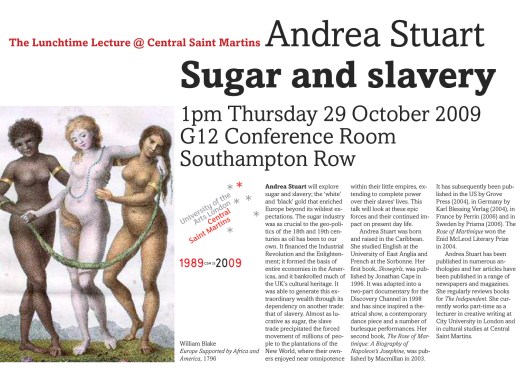
Before posting the second rather long post on the issue of ‘The Critique of the Biennale Circuit’ I felt the need to post a quick and direct missive in response to a talk I just went to on the issue of ‘Sugar and Slavery’ by Andrea Stuart. The talk made me realise why I have so much trouble writing on the issue of critique and criticality. I have worked out that I have such a massive reserve of negative criticism about the current state of artistic, cultural and academic life-words I inhabit that I often find myself lost for words in the face of it.
I think I can encapsulate the object of my rage today, and probably for some time, in three words – Liberal Bourgeois Normativity. I will leave my pedagogical head off for the time being and refrain from defining precisely what I mean by these words and their theoretical history etc. But it is everywhere in my world and at times it has driven me mad. I realised that in order to survive in the world of academic employment I have had to work very hard at tempering and refining my class anger, of converting it into palatable, polite forms. That’s not such a bad thing in itself. I don’t particularly enjoy being angry and frustrated all the time. So it’s really not so bad on a ‘personal’ level. But I fear that writing this blog for the Ghetto Biennale is tempting the cat of criticality out of the bag of repressed class rage.
Andrea Stuart is currently writing a book about ‘Sugar and Slavery ’which grew out of earlier scholarly research into 18th century colonial history and the fact that one of her ancestors was a white plantation owner in Barbados. Her earlier books included Showgirls a book about glamour, Josephine Baker and the burlesque tradition and one about Josephine Boneparte: Josephine: The Rose of Martinique. I should have known. Glamour and Slavery eh? Interesting. But I didn’t pre-judge. In fact I thought that this was a potentially very interesting correlation of ideas to explore, and still do. But I started to get suspicious feelings noticing the way the speaker subtly stroked her hair as she spoke about the unimaginable affluence of her sugary aristocratic forefathers and the similarities with contemporary Russian oligarchs.
The talk itself was clear and informative. The body-language probably all in my paranoid imagination. For those who didn’t know much about the role of slavery in the sugar trade and the scale of the barbarism involved this was probably an enlightening introduction to the topic. But for some reason the way she told the story kept making me think of the Marquis De Sade, the first chapter of Foucault’s Discipline and Punish and all things gloriously cruel and Bataillian: the horribly seductive glamour of wealth, sumptuary expenditure, limitless sovereign power and murderous cruelty etc, etc. Which is fine. These are important issues and as relevant today as they were in the 18th century. Except she wasn’t talking ‘explicitly’ about them. She proffered no theoretical speculation about why unimaginable opulence might accompany unthinkable barbarism. One had to assume, given her introduction, that in some mysterious way it was the sugar’s fault.
“Sugar, in a profound sense, made us” she said.
So after an interesting and thought provoking 40 minutes the proceedings were opened up for questions from the audience. I was shaping one up – something like “Do you think that by treating sugar as the mysterious material ‘cause’ of your cultural identity you may be avoiding the bigger socio-economic picture of which sugar and slavery (like the oil and warfare of today, to which you likened them) are an integral part?” –when the first question came from the floor. A young woman, who had been taking notes copiously throughout the talk asked in a plummy English accent (which is very important in this context. For those readers not familiar with British culture and society it is hard to articulate how drenched with class politics our accent system here is):
“I hope you don’t mind me suggesting this. But are you in some way saying that, without sugar and slavery, you and other people from the Caribbean would not be here with us today and that, as a consequence of it, our culture is now much richer and diverse than it was before? So in some way it was a good thing? ”.
“Well of course, this is a difficult thing to talk about. But certainly if it wasn’t for the sugar trade we wouldn’t have the richness and diversity of the multi-cultural society we have in Britain today. Just think of things like Jazz. You couldn’t have had that without slavery”.
I didn’t ask my question. My critical gaskets had blown again. So I wrote this instead.
‘Critical theoretical practice today is caught within the prison house of its own academic debates. We are confined within the globally extended theory world, as artists are within the globally incorporated art world’
Susan Buck-Morss – Hegel, Haiti and Universal History (p.139)
I had intended to use this quote to open the first post of the blog for some time but in the three weeks since I set up Zombie Diaspora I’ve been unable to find that special ‘extra’ prompt that would make me stop procrastinating and actually start writing, to put the first post in the blogging ground.
And in the end it was not this quote that did it. It was another, much more obtuse trigger that I will get to later. But the above quote has the value of being relevant to the immediate purpose of the blog and for bringing together two of the three inter-related themes that have been proposed for Ghetto Biennale Conference: the ‘Critique of the Biennale Circuit’ and ‘Of Revelation and Revolution’
It is the latter theme – which will explore the relevance of Haiti’s revolutionary history for contemporary art – that I feel most comfortable and confident addressing here. That’s why I chose to begin the blog with a quote from Susan Buck-Morss. I will write more about the critique of the biennale circuit later in the blog. But for the time being I’d like to stay in the cosy and reassuring environs of critical theory and cultural history.
In the run up to writing this first post I have been working on two other distinct but inter-related projects. The first is the development of the curriculum content and reading list for a course called the General Theory Forum which I teach at Chelsea College of Art and Design in London (henceforth the GTF). The GTF introduces postgraduate art and design students to a range of theoretical concepts, discourses and debates which help them to contextualise their creative practices in critical, contemporary and theoretical terms. Because the students come from a diverse range of international and educational backgrounds I try to find primary readings for each topic (e.g. ‘Identity and Difference’, ‘Culture, Taste and Distinction’) that can serve as general introductions to the subject area. Each year I try to update and adapt the syllabus and find new and better readings for each lecture. The course begins in two weeks time. So that’s what I’m doing now.
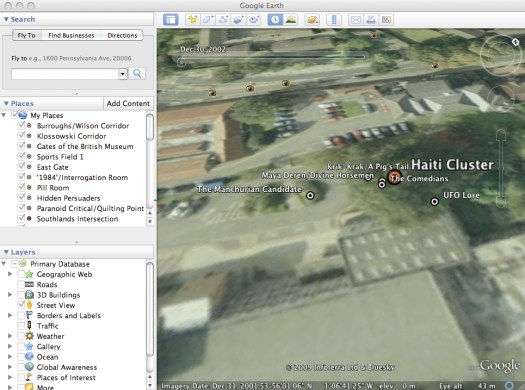
The second plate I have been spinning is a presentation for a forthcoming event called ‘Performance Fictions’ organized by the Art-Writing-Research-Network at Birmingham University. I’ve been entertaining the idea of formally developing a notion of ‘Paranoid Critical Theory’ as a research/writing method for some time now and have been given the opportunity to do so to public audience later this month. In order to present the theory I will be relying on and demonstrating an idiosyncratic, subjective archiving system that first revealed itself to me when I began to read ‘theory-in-general’ with-a-mission, as it were, during my first academic degree in Art History and Theory at Essex University in 1986. The intellectual-academic mapping system which emerged involuntarily at that time built itself upon the territory of my home town in the north of England. Upon the ground of York many clusters of academic, textual, and literary ‘information’ have become invisibly mapped in fixed locations, usually in the environs of my earlier learning institutions. When I take in new information, stuff that makes me think ‘theoretically’, it tends to gravitate ‘unconsciously’ to these specific places, as if there was a phantom librarian wandering around the maps of my memory, archiving books and ideas according to a delirious indexing system known only to them.
I have been aware of this mapping system for twenty years or more and have tried to analyse, interpret and represent it several times before. Although my relationship with the system occasionally (or in some places) borders on the hysterical, today I’m not worrying too much about who or what the phantom librarian is, or why he/she processes the information the way that they do. It is simply always there, quietly, in place. And whenever I work on some theoretical-writing project it gradually comes in to focus on the backdrop of my mind’s eye.
Since the co-ordinates of ‘Paranoid Critical Theory’ are firmly mapped on this memorial ground, it is currently proving (with the miraculous assistance of Google Earth) a particularly useful way to outline the academic pre-texts for the theory that I intend to present in Birmingham (henceforth PCT). Furthermore, in the process of mapping the co-ordinates of PCT I inevitably encounter the archival co-ordinates of Haiti on my biographical map (arbitrarily situated in an open area between the exam hall and coffee bar of the technical college I attended when I left secondary school in 1980. The three essays posted on the Pages section to your right, for instance, were written with here as the backdrop).
So these are three spinning plates that I am trying to keep in the air as I attempt to get this blog rolling: the GTF, PCT and the Ghetto Biennale Conference (henceforth the GBC).
Two days ago I awoke thinking about PCT project, remembering an important co-ordinate cluster that needed to be marked on the Google Earth map. Close to the finishing line of the race-track in York my secret librarian had placed two texts by Freud; the first ‘A Note upon the Mystic Writing Pad’ and the second a section from Civilization and its Discontents where he reflects on the archaeology of Rome as a metaphor for the layering of memories in the brain (a section which, incidentally, I have quoted in full in the ‘Spectral Futurology’ lecture posted in the ‘Pages’ section to your right).
As I put the place-markers for these texts in the map I realised that another key text was hovering over the same area, one which seemed to hold the others in place: Jacques Derrida’s chapter on ‘Freud and the Scene of Writing’ from Writing and Difference. I quickly googled the book, found the chapter and began to read it again. As I did so I immediately felt the urge to take notes from the text and to copy out this particular sentence: ‘Despite appearances, the deconstruction of logocentrism is not a psychoanalysis of philosophy’. As I did so I realised that I could use this quote for the GTF as an example of the kind of ‘high-end’ theoretical construction that, at the beginning of the course, I would expect few of the students to understand. If, by then end of the course, they had some level of understanding of the sentence, I could use it as a measure of how well the course had worked. It was just an idea. Worth noting at least. So I did.
And then, as I began to write it out, plate one spun into plate two, plate two spun in turn into plate three, and I realised that this sentence might be the very quote with which I could being the GBC blog.
Which is what it was. And here’s why. It takes us back to Buck-Morss.
I was first prompted to read Hegel, Haiti and Universal History after attending a conference ‘On the Idea of Communism’ at Birkbeck College in London in March this year at which Slavoj Zizek gave a talk entitled ‘To Begin from the Beginning over and over again’. In it Zizek spoke about the Haitian revolution in the context of his discussion of the 4th great challenge we face in an age of ‘capitalism gone mad’: the loss of an antagonism between the included and the excluded that might be strong enough to prevent capitalism’s indefinite reproduction. It would be too much to summarise Zizek’s argument here (overviews of Zizek’s position can be found at Lacuna 2.0 and Pinocchio Theory) but it is worth noting in terms of a particular revolutionary Haitian current running through contemporary critical theory and political philosophy at the moment, one exemplified by Buck-Morss, Zizek and Peter Hallward for instance, who also spoke ‘On the Idea of Communism’.
But it is not simply an association with ‘high theory’ through one of it’s most high-profile contemporary representatives (i.e. Zizek) that makes the Derrida quote point back to Buck-Morss, but the way it resonates with one of the sections of her book that I had not intended to write about. For the PCT project I had begun thinking about Critical Theory in terms of the popular blue and red pill dilemma from the film The Matrix (1999) (Zizek had already reflected in this in The Pervert’s Guide to Cinema) What I mean to suggest by ‘The Red Pill of Critical Theory’ is that approaching ‘one’s self’ and ‘the world’ from its multiple perspectives can seem to have an irreversible effect on one’s reality picture, that once you have learned to see the world through the bi-focal lenses of Marxism and Psychoanalysis in particular you can never return to a place of ontological innocence, to a place of un-knowing.
It is with reference to the complex relationship between these two dominant discourses of critical theory that Derrida’s sentence brings us back to Buck-Morrs’ ‘First Remarks’ in the ‘Universal History’ section of Hegel, Haiti and Universal History in which she expresses her intention to “unearth certain repressions surrounding the historical origins of modernity” and “to reconfigure the enlightenment project of a universal history in the context of our too-soon and not-yet global public sphere”. To do so she discusses three images which she approaches as a rebus (in the manner of Walter Benjamin) in order to ask what happens if we consider Haiti as an agent in Europe’s construction rather than as its victim. (Echoing Buck-Morss, Zizek suggested in his Birkbeck lecture that ‘we’ need the Haitian revolution to understand European communism).
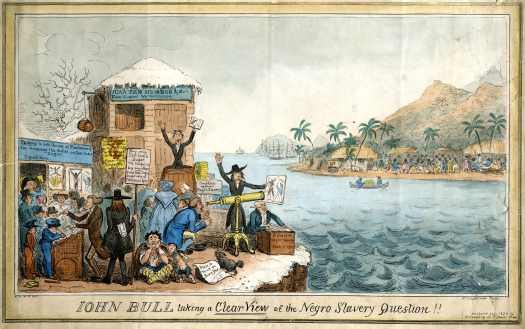
The first image is an illustration to Voltaire’s Candide from 1787 in which the central protagonist of the novel encounters a slave in the Dutch colony of Surinam who has been physically mutilated by his master. The caption of the illustration consists of the slave’s final words: “It is at this price that you eat sugar in Europe”.

When the illustrator Jean-Michel Moreau designed a second series of prints for the 1803 edition, this scene was omitted. Buck-Morss argues, following Mary Belhouse’s analysis of the imagery in her article ‘Candide Shoots the Monkey Lovers’, that this omission is a consequence of the slave revolution that had subsequently taken place in the sugar rich French colony of Saint-Domingue and that the shift in representational strategy was characteristic of a post-revolutionary tendency in French visual culture to replace depictions of blacks as “infantilized, subservient, and dismembered” subjects with representations of them as “physically violent and dangerously sexualized actors” who reduce whites to “bodies in pieces”.

Bellhouse analyses Moreau’s early image through the lens of psychoanalytic theory discovering “multiple signifiers of ‘phallic’ power in the hands of whites”. It is an approach which Buck-Morss is critical of and one which the Derrida quote reminded me of.
While acknowledging the theoretical value of Freud’s hermeneutic methods for cultural analysis, she argues that “something is lost when the theoretical apparatus of psychoanalysis is mapped directly on to a political analysis of the collective unconscious, lost to both sides of the interpretative process, the personal (psychological) and the political (social)”. She continues:
‘[I]f there is anxiety expressed in the image of the mutilated slave, we ought not to exclude consideration that it was lodged in the reality of the social situation, which cannot be reduced the castration fears of men…Not all guilt is sexual in origin…The figure of Candide expresses the undeniable political experience of guilt that we humans feel when witnessing something deeply wrong with the principles that govern our everyday world’.
The spur of Buck-Morss criticism of the psychoanalytic approach is expressed most emphatically in a footnote, in which she writes:
‘To see fear of castration as the source of European racism, propelled by rumours of atrocities committed by rebelling colonial slaves, and to read that fear in the visual stereotypes in the “atrocity prints” of physically threatening, sexualised black males, is to short-circuit precisely the historical specificity that Bellhouse’s research so brilliantly discloses. In adopting the pre-Oedipal, Lacanian language of desire and loss (the maimed slave figures as Lacan’s “body in pieces”), she is led to ahistoricity against her intent’.
To support her argument Buck-Morss then recounts an anecdote the story of the French soldiers, on arriving at Haiti in order to reclaim it, heard the self-liberated slave army singing the La Marseillaise and questioned whether they were fighting on the right side. (Zizek, incidentally, used the same anecdote to illustrate his argument about the Hegelian-Universal claims of the French revolution – i.e. it’s first repetition and thus the first concrete realization of its proper universality). Buck-Morss uses the story to illustrate how guilt can derive from the gap between reality and social fantasy (i.e. the universality of the ideals of the French revolution) rather than between reality and individual fantasy.
The second rebus brought in to play by Buck-Morss is a waking vision reported by Baruch Spinoza, the 17th century Dutch philosopher, reported in a letter to a friend in 1664 “of a certain black and mangy Brazilian, whom I had never seen before”. Though Spinoza championed the rights of the physically empowered “multitude” he was blind, as were most later Enlightenment thinkers, to the social exclusion ‘with which the multitude was riddled’ (Buck-Morss). Following Warren Montag in Bodies, Masses, Power: Spinoza and his Contemporaries (1999) Buck-Morss argues that this figure is a “condensation of all those whom Spinoza would legally deny a voice…[who] taken together comprise a numerical majority in any given society: women, slaves, wage-laborours, foreigners…They are the multitude whose real power no laws, no constitution can make disappear and whose very existence political philosophy seeks precisely in its most liberal forms to deny”.
The final rebus for us to ponder is an image from the life of Adam Smith, author of The Wealth of Nations (1776), the book which, as Buck Morss notes in her introduction to Hegel, Haiti and Universal History, profoundly influenced Hegel’s early philosophy civil society, the modern state and the ‘system of needs’ (Buck-Morss p. 3 – 20). Smith, a moral philosopher who condemned slavery as an “intolerable obstacle to human progress”, had one distinct vice: his fondness for sugar. She recounts the story of Smith compulsively stealing lump after lump of sugar from the tea-table of an elderly maiden lady: “his appearance mumping the eternal sugar was something indescribable”.

On this blog I will be discussing some of the the issues and ideas that emerge as we develop the conference project for the Ghetto Biennale that will take place in Port-au-Prince, Haiti in December 2009. In the pages section I have posted three essays/talks that I have written on the subject of Haiti, Vodou and their respresentations in Western popular and academic culture. I hope these will help to contextualise the texts and issues I address in the blog. Please feel free to comment on these or related issues.
 Invisible Mirrors