Ponto for Banbha Mooira (2012)

Above is a video document of the drawing of Ponto for Banbha Mooira, a ritual floor drawing to an invented deity created by Roberto N. Peyre and myself in June 2012 for the exhibition ‘THERE IS NOT AND NEVER HAS BEEN ANYTHING TO UNDERSTAND!’ at ASC gallery in London. The drawing was made and filmed in the place on the gallery floor that it would be projected onto for the duration of the exhibition. The show was curated by our good friends Plastique Fantastique.
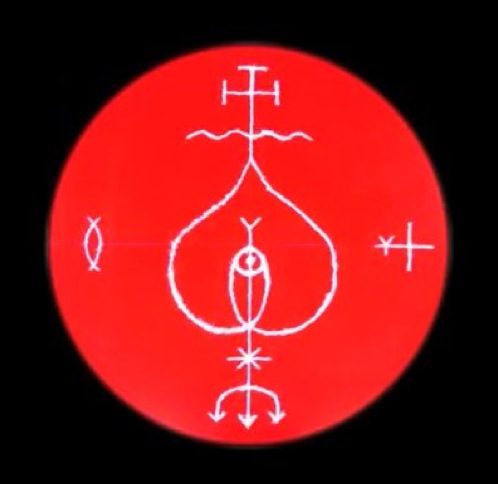
Final Version of the Ponto

The artwork was inspired by our shared interest in Black Atlantic religions and Northern Soul dance culture, their common spiritual foundations in the transatlantic slave trade and the struggle for liberation, the importance of ritual dance/possession trance in both traditions, and processes of subject formation within industrial labour. The work was conceived as a mystic re- or counter-communion with antedeluvian origins and alliances in order to break the chains of assembly lines and loop holes guarded by certain demonic forces.
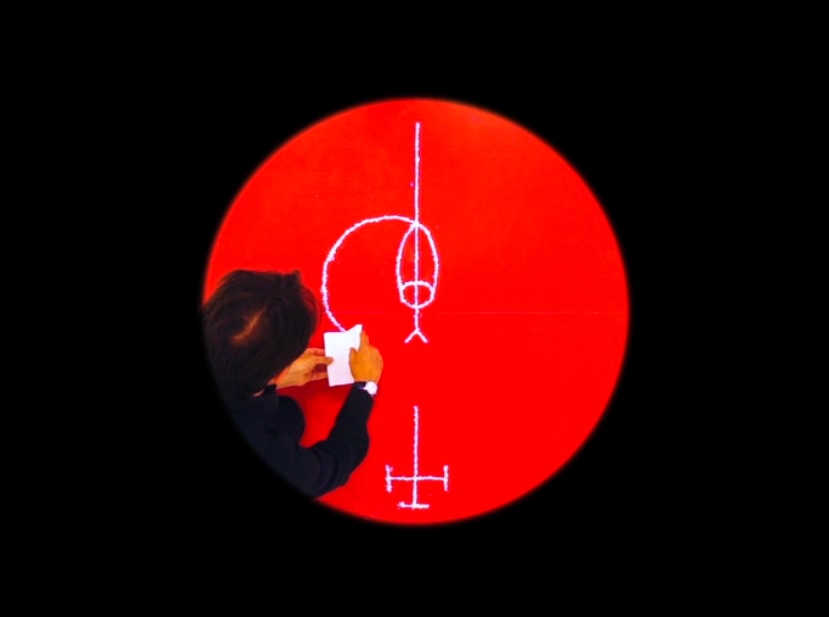
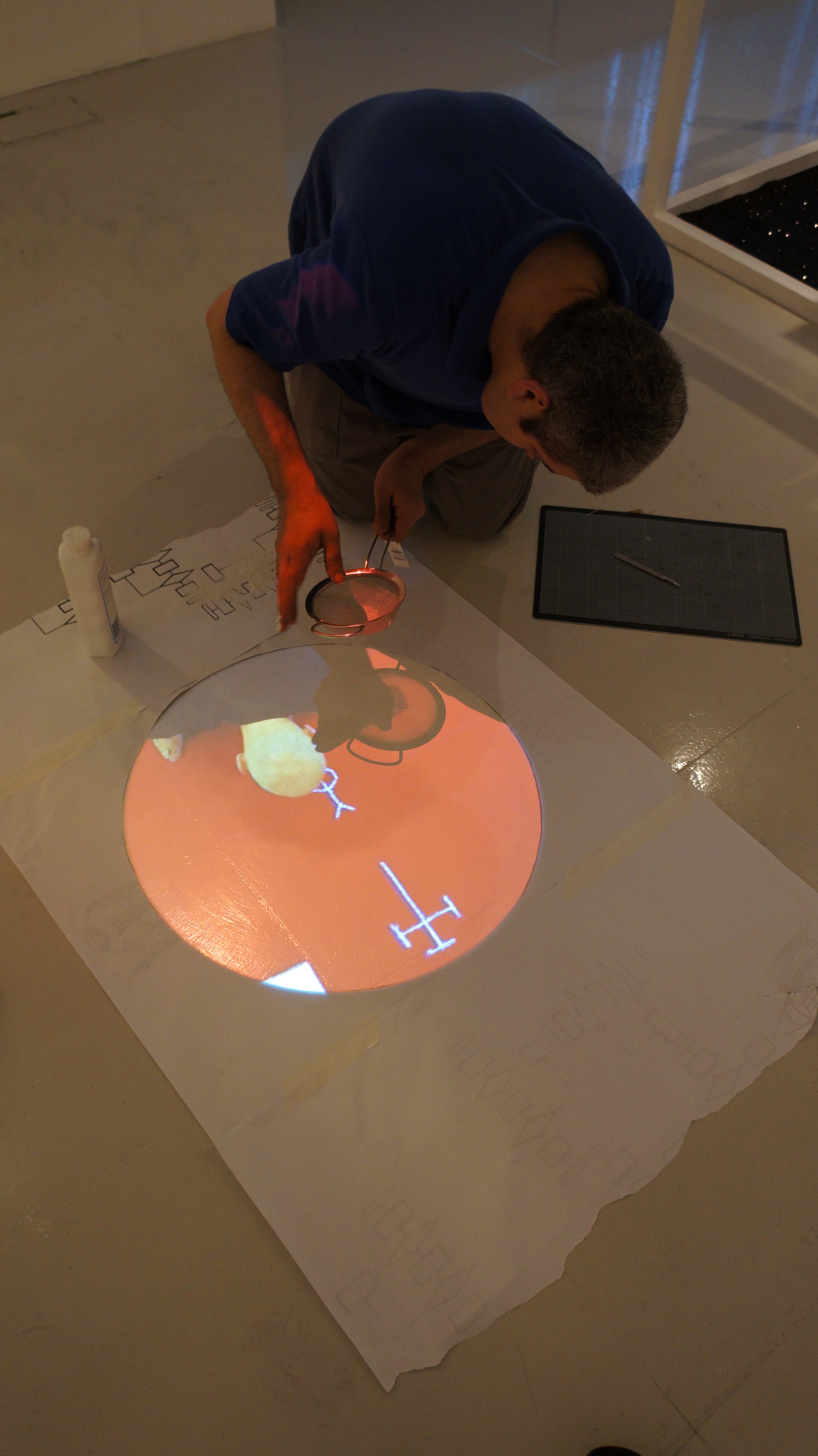
At the end of the drawing Roberto and I ‘un-draw’ the ponto by dancing and spinning on it to the sound of Spirit by Third Point, a Northern Soul tune, rarely heard these days, but once a big hit in the Highland Room at Blackpool Mecca, one of the most important Northern Soul venues in the 1970’s. The drawing is finished by 39.15. Then the dancing starts. The final video, embedded above, was projected onto from the ceiling onto a circle of white powder.

Installation View of Ponto for Banbha Mooira

The project began with a view to making a vévé: a ritual signature of a Loa (God/Spirit) drawn in powder on the ground during Vodou ceremonies in Haiti. Roberto suggested we think about what a Northern Soul vévé would be made of. The content of the powders should be in keeping with the work to be done and the spirits to be honoured. The obvious choices were talcum powder, which Northern Soul dancers sprinkle on the floor to make it easier to perform their dance moves, and amphetamine sulphate, the stimulant of choice for the scene.

At the time we were developing this project I was exploring the history and symbolism of the red cross after rumors had begun circulating that the International Red Cross was planning to build a hotel and conference centre in Haiti with money raised from public donations for post-earthquake disaster relief, allegedly with the intention of creating jobs for Haitians. At that time the red cross had become emblematic of the mutual interdependence of military violence and charitable aid that had been cast into stark in post-earthquake Haiti. Given that the ASC gallery is located in Southwark, an area with a with a long history of  Black African presence related to the transatlantic slave and sugar trade, Roberto suggested twinning the area with the other side of the river and its square mile of notorious Templar power and financial necromancy. He also suggested we start to think about spiritual power centres in the vicinity of the gallery where we could perform ritual works. Specifically we should look for a Pomba Gira “hot-spot”. Pomba Gira is a deity within the Umbanda, Quimbanda and Candomble spiritual traditions of Brazil. Her name means “spinning” or “turning dove” in Portuguese. She is a powerful warrior-queen who takes many forms and “paths” through which she commands formidable legions of the dead. She is often associated with “wayward” female behavior like promiscuity, prostitution, hedonism, intoxication and violence and she inhabits liminal spaces like forests, riverbanks, crossroads and graveyards. She is the consort of Exu, spirit of the forest and prime spirit of change, first action, streets, roads, transmissions and crossings and the name given to a phallanx of spirits on the lowest level of the spiritual hierarchy in the Qiumbanda tradition.
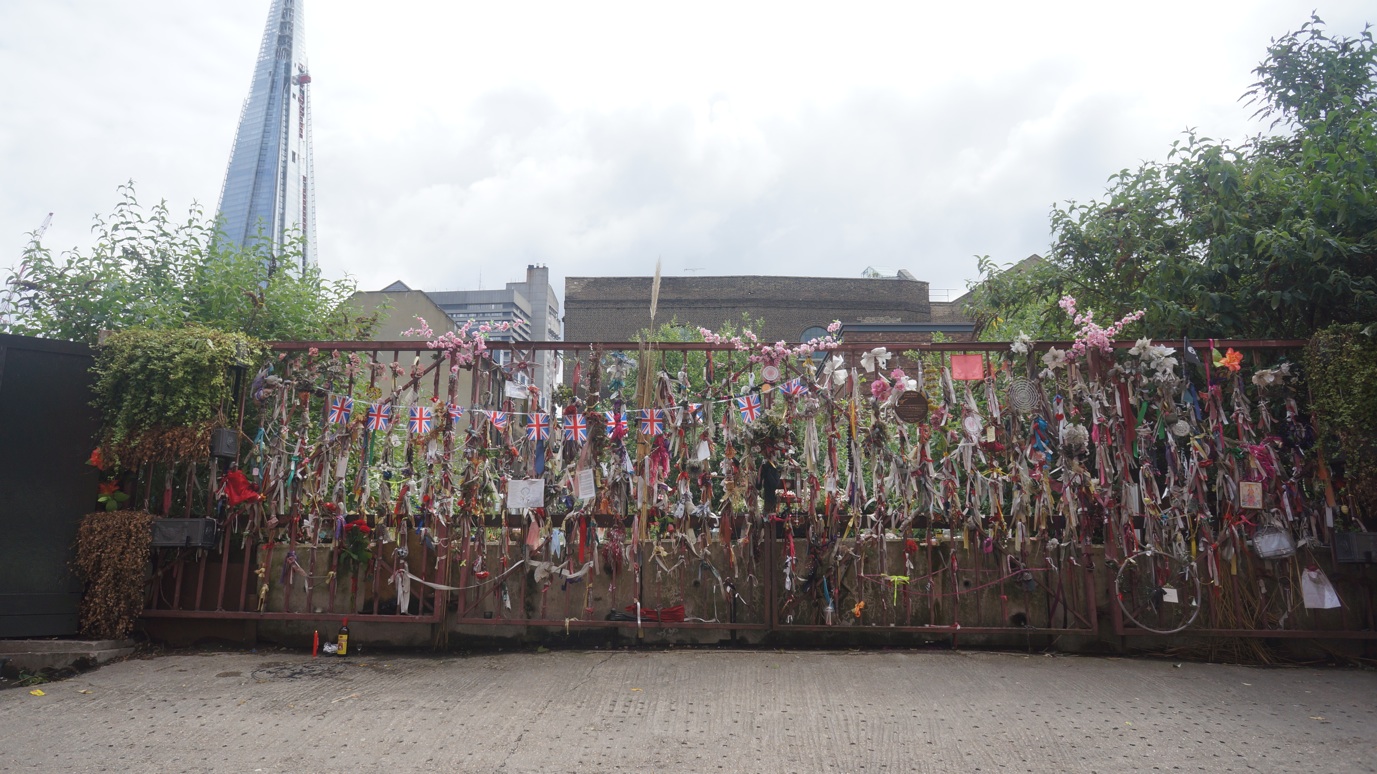
Gates to the Crossbones Graveyard, Southwark.

As we began to reflect on the nature of the vévé powder and the quest for a Pomba Gira hot-spot in Southwark, an image of a skull and cross-bones came to mind: the bones being ground into a white powder in a mortar and pestle. Cross-bones and graveyards. And then I remembered The Cross Bones graveyard, a ceremonial site for the memory of the outcast dead (especially for prostitutes), made popular by the mystic, visionary poet and playwrite John Constable (aka John Crow), whose Southwark Mysteries were channeled to him by the spirit of a dead prostitute called The Goose. And it was on Redcross Way, in the parish of St. Saviour’s, no more than seven streets from the gallery.
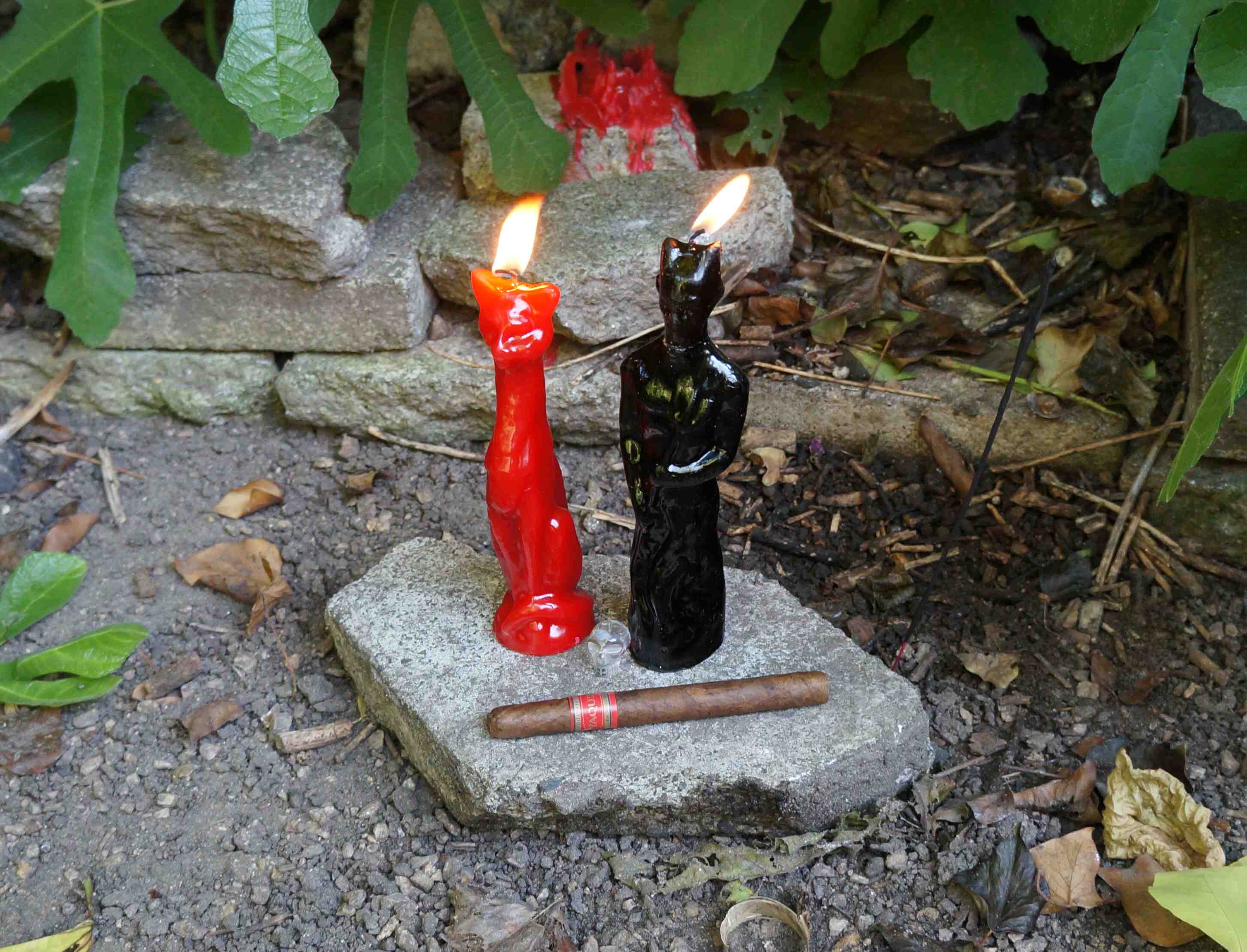
Over the next two weeks – during the transit of Venus – we performed a number of rituals in recognition of Pomba Gira dos Sete Cruzeiros de Kalunga (Pomba Gira of the Seven Crosses of Kalunga) at the gates of the Cross Bones burial ground, and to Exu Quebra Galho (Exu of the Broken Twig) at the base of a fig tree in All Hallows Church yard. We then designed a ponto riscado, the ritual signatures of deities and forces within Quimbanda, for a transatlantic Northern Soul deity that Roberto named Banbha Mooira after the legendary warrior queen and giantess founder of Ireland and a fateful, Moorish Moira. The ponto contains a number of elements: the tree of life encircled by a double-headed serpent, the graveyard oceans of Kalunga, the cross of the Knights Templar and the trident of Pomba Gira. The ponto was worshipfully drawn to our new queen on the Diamond Jubilee of another queen, Elizabeth II of Jamaica, Barbados, the Bahamas, Grenada, Papua New Guinea, the Solomon Islands, Tuvalu, Saint Lucia, Saint Vincent and the Grenadines, Belize, Antigua and Barbuda and Saint Kitts and Nevis.

In the rendering above the ponto is inverted.
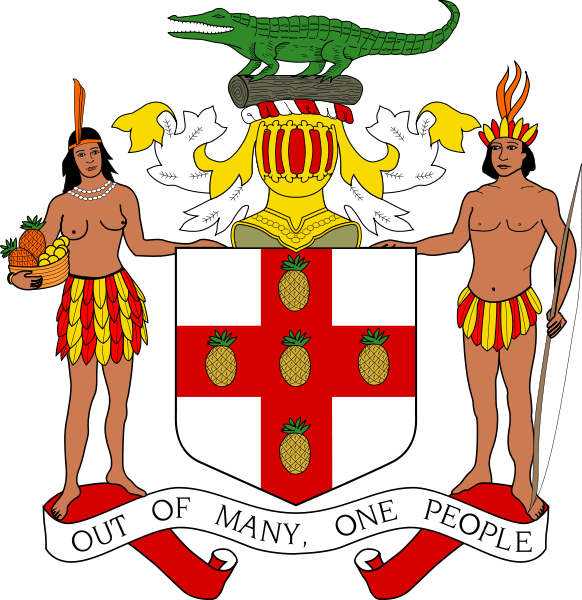
582px-Coat_of_Arms_of_Jamaica.svg

Doc of the Dead

Here’s a trailer for what I presume may be the first full-length documentary about the “zombie emulator” phenomenon. My favorite comment has to be George A Romero’s, which raises a fundamental problem for any would-be “zombie ethnographer”:

“I’ve been to Mexico City and 5,000 zombies showed up. And I can’t get any of these people to answer the basic question of “WHY DO YOU DO IT?””

The Militarization of Aid

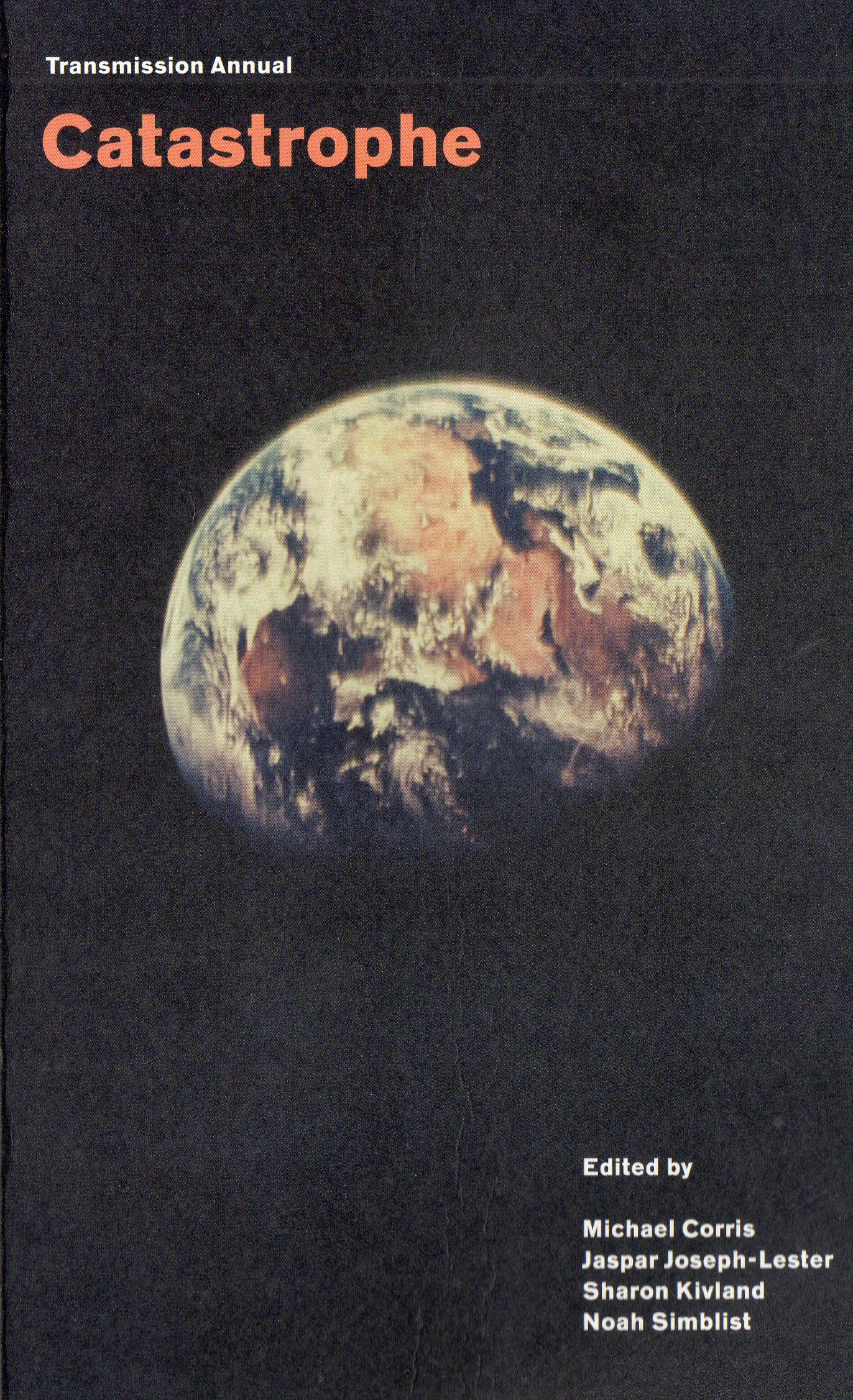
Here is a PDF of my essay ‘The Militarization of Aid as an Act of Religious Violence’ which was recently published in the Transmission Annual publication on Catastrophe. In the essay I reflect upon the militarization of aid in post-earthquake Haiti from the perspective of George Bataille’s Theory of Religion.

Catastrophe Cover020

Morpeth School – Art Power

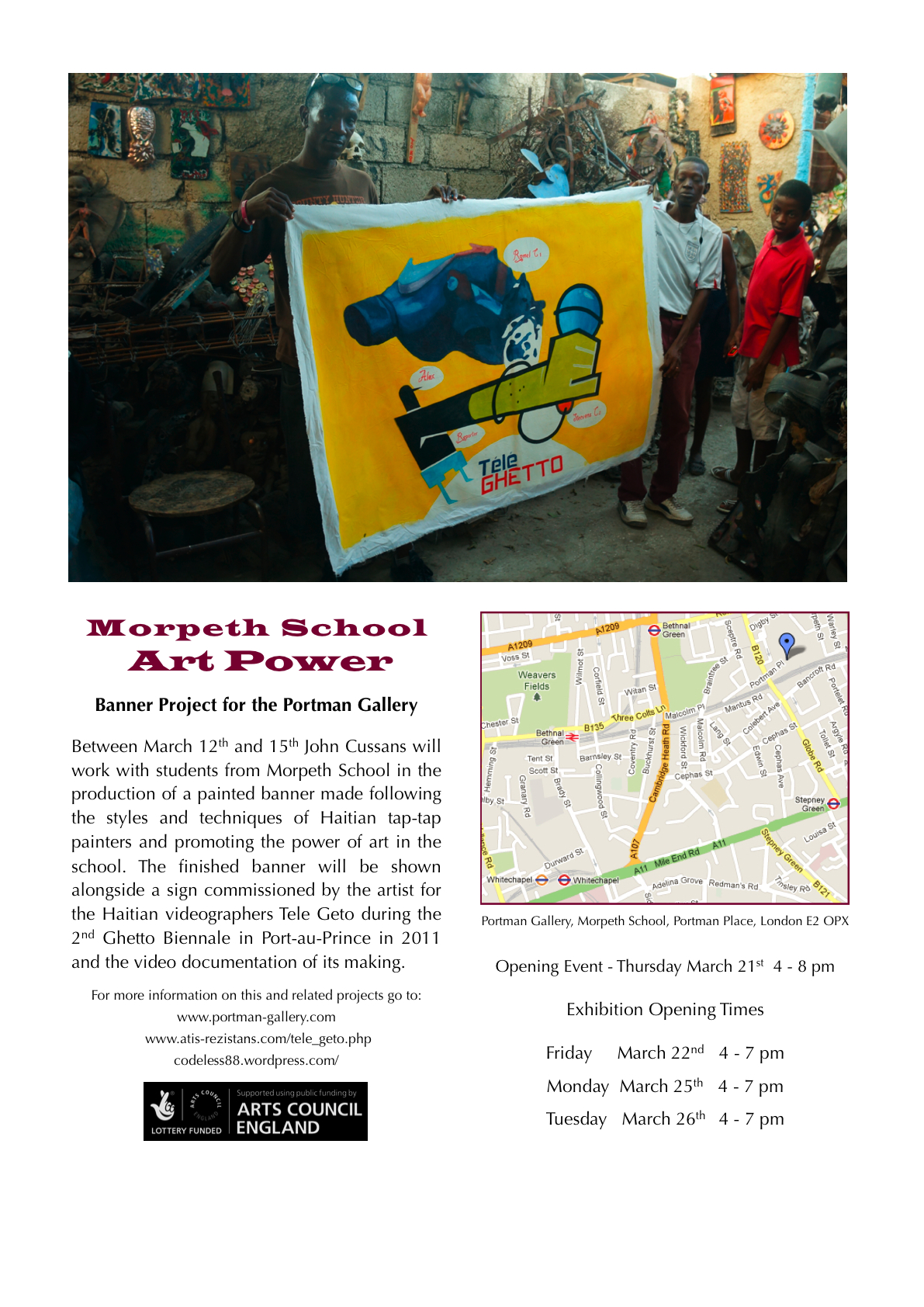
Next week I will be working with students from Morpeth School in Bethnal Green to produce a large scale banner based on the working methods and styles of Haitian tap tap painters. The finished banner will be shown alongside the sign made for Tele Geto during the last Ghetto Biennale and the video documentation of its making. The exhibition will take place at the Portman Gallery, Morpeth School, Portman Place, London E2 0PX. There will be a wine reception in the gallery from 6 till 8 on Thursday March 21st. All welcome.

Details below (click on flyer for higher resolution). Art Power E-Flyer Final (jpg)

Achantè

This is a trailer for the exquisite Achantè, a short film-portrait of Haitian Vodou made by Emily McMehen and Geoffry Sautner (aka Mazibel Productions) in collaboration with a small international production team and four Vodou communities in the South of Haiti. Emily showed an earlier version of the film at the 2nd Ghetto Biennale. More information about this hypnotically beautiful film can be found here.

Zombies Counter Recession

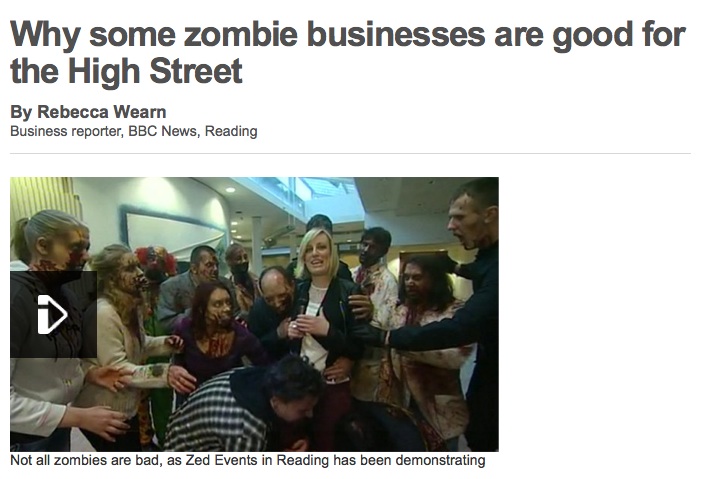
Here’s a link to a recent BBC business news article about how an organization of apocalyptic cannibal zombie emulators have become involved in attempts to regenerate a local shopping mall in Reading.

BBC Zombie Mall

In the article a representative from the Local Data Company – which collects nation wide data on the use of retail and leisure premises – tells the BBC “Shops are having to change their use – distinction is the key word – consumers really want something different from their High Streets.” So it looks like your local run-down shopping mall may soon be filled with gyms, crèches, art galleries and zombie emulators, “putting the heart back into the High Street”.

(Zed Events, the company that organizes the zombie apocalypse emulation activities, is currently looking for would-be zombies who will be eradicated by the other fee-paying participants. They are charging a fee of £119.00 for the pleasure.)

1804 and Its Afterlives (Part Two)

This is the second of a three-part summary of the excellent 1804 and Its Afterlives conference that took place at Nottingham Contemporary on December 7th and 8th 2012 as part of the events program accompanying the Kafou: Haiti, Art and Vodou exhibition. Video recordings of the sessions can be found on the above link. The focus here is on salient points from the talks that touch upon issues of direct relevance for the Zombi Diaspora narrative and the Ghetto Biennale.

Saturday 8th (Day Two, Morning Session)

This session was introduced by Philip Kaisary, assistant professor of Law at the University of Warwick who has written about representations of the Haitian Revolution in the work of Aimé Cesaire and C.L.R. James from the perspectives of human rights discourse and historiography. He spoke briefly about “the extraordinary diversity of the Haitian revolutions afterlives” not only in literature but also in film, music and dance, these latter being the focus of the morning’s papers.

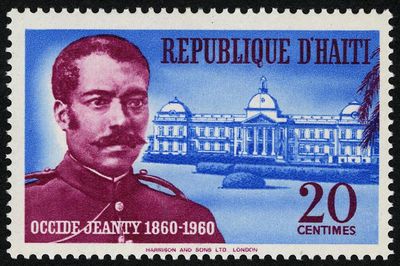
The first speaker was Michael Largey, Professor and Chair of Musicology at the University of Michigan and author of Vodou Nation: Haitian Art Music and Cultural Nationalism (2006) whose paper 1804 and Musical Memory: Occide Jeanty and Recombinant Mythology in Haiti’explored how Haitian art music has been used to underscore concepts of nationalism there. In Vodou Nation he claimed that elite Haitian composers employed “modes of cultural memory to engage issues from Haitian history as a way to make significant claims about Haiti’s place in the world”. Today he spoke about one such mode, “recombinant mythology”, to show how “mythological ideas” have a powerful shaping influence on how Haitians understand their political realities. He focussed on Haitian military band director Occide Jeanty (1860 – 1936) who was seen by Haitian audiences as a defender of the Haitian nation during the 1915-1934 US military occupation. In order to understand the importance of Jeanty it is necessary to develop a historical model that examines “legendary accounts of his life that have been infused with Haitian myths”. “Myth and history” he says “are elements of larger discursive processes that forge relationships with the past”.

Occide Jeanty stamp

Continue reading “1804 and Its Afterlives (Part Two)”

A Pig’s Tail

At long last Leah Gordon & Anne Parisio’s inspirational film A Pig’s Tail (1997) is up on Vimeo. Thanks for that!

There have been several references to the story of the Haitian pig here at Zombi Diaspora. It is the “same pig” that Reginald Jean Francois spoke about in his story about the 2004 defacing of the replica of the Florentine Boar by UN troops in Haiti.  The story resonates very strongly with Colin Dayan’s talk at the 1804 and Its Afterlives conference discussed in the previous post, especially in terms of the competing justifications and rationales for animal slaughter/sacrifice. The description of the ceremonial welcoming of the all-new American pig to the island sounds like the kind of legal ritual she has been writing so insightfully about. It is also, on a more optimistic note, probably the ancestor the the ‘hybrid’ pig she encountered when she was last in Haiti. 

Although it was “Baby Doc” Duvalier’s Tonton Macoutes who carried out the extermination program, we should note too the central role played by USAID, whose director from 1977-79, two years prior to the total eradication of the creole pig from the country, was Lawrence Harrison also mentioned by Dayan, who in the interview linked to in the previous post and elsewhere, argues for a “cultural revolution” in Haiti (and Benin) to totally eradicate Vodou from the minds of its people on the grounds that it “gets in the way of democratic governance, social justice and prosperity”. The irony of this claim is made painfully clear by the Haitian’s interviewed in Leah and Anne’s film who explain how the Haitian pig helped them put their children through school, pay for medicine, buy land or build a house. As A Pig’s Tail shows so well, the pragmatic realms of utility and mysterious realms of the sacred are not so easily separated in Haiti.

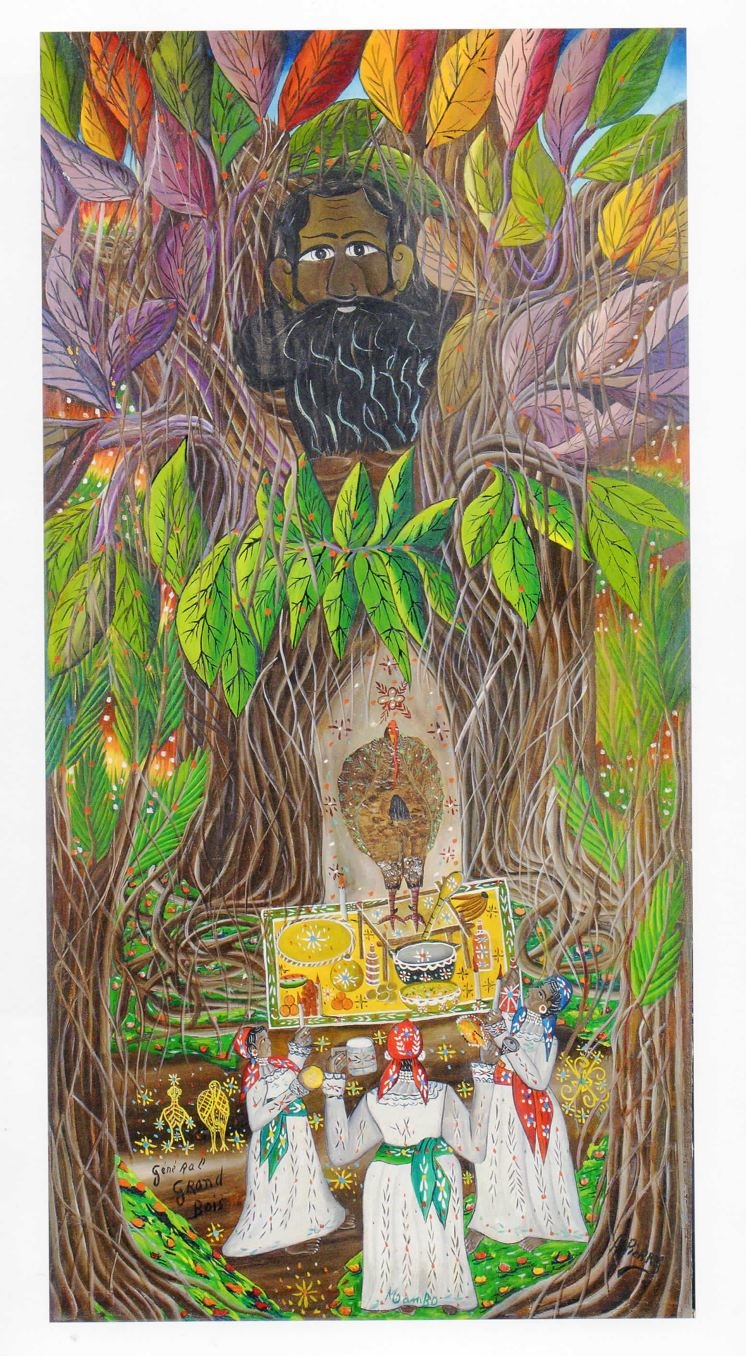
Great to see once again the meeting of Edgar Jean Louis, Vodou priest and flag-maker, and Andre Pierre, the person who taught him the way of the spirits who is one of the key painters exhibited in Kafou exhibition.

André Pierre 'Ceremonie Vodou' (1970)
André Pierre ‘Ceremonie Vodou‘ (1970)

1804 and Its Afterlives (Part One)

This is the first of a three-part summary of the excellent 1804 and Its Afterlives conference that took place at Nottingham Contemporary on December 7th and 8th as part of the events programming accompanying the Kafou: Haiti, Art and Vodou exhibition. Video recordings of the sessions can be found on the above link. I will focus here only on salient points from the many inspiring talks that touch upon issues of direct relevance for the Zombi Diaspora narrative and the work of the Ghetto Biennale.

Friday 7th (Day One)

The keynote lecture  – ‘The Gods in the Trunk (or Writing in a Belittered World)’ – was given by Colin Dayan, author of Haiti, History and the Gods (1995) and the recent The Law is a White Dog: How Legal Rituals Make and Unmake Persons (2011). Her talk offered “a context for reconfiguring our understanding of the supernatural…that asks: What could we feel if we could feel what we experience sufficiently?” Prompted by her knowledge and experience of Vodou practice she questions the meaning of justice, the reach of cruelty and the uses of  reason within the generally decorous and polite academic discussions of ‘humanism’, ‘humanitarianism’ and ‘human rights’, in an attempt to “breach the gap between body and mind, dead and living, human and non-human”.

Her focus on the language of ‘humanism’ and ‘humanitarianism’ has bearings for earlier posts that have addressed post-earthquake disaster relief as a form of neoimperialist violence that masks and intensifies the suffering of the populations it claims to be aiding. As I have argued in a forthcoming text for the Transmission annual on Catastrophe, the militarization of aid in post-earthquake Haiti was an intensification of the strategic utilization of humanitarian aid as part of an ongoing neoliberal strategy that has been undermining the possibility of Haitian popular sovereignty since the Duvalier era. There is a kind of humanitarian wall built around Haiti that hides and prevents access to the real violence being waged there in the interests of a tiny international, capitalist elite. The systematic suppression of Vodou, despite not beginning with it, seems to intensify during periods of occupation, significantly during  the US occupation of 1915 to 1934, the UN occupation beginning in 2004 and the second phase of US occupation that began after the earthquake in 2010. President Martelly’s recent repeal of Article 297 of the Haitian constitution, and the arrest of Ougan Zaza and nine other participants at the annual Bwa Kayiman ceremony this year, suggest that a renewal of the anti-Vodou program may be underway. At the same time, as Reginald Jean Francois’ account of the defacing of the Florentine boar in Plaza Italia by UN peace-keepers in 2004 suggests, there are aspects of the MINUSTAH mission that exceed ‘pure’ security and stability objectives.

Dayan began her lecture with a question – “What is the particular terrain for human cruelty and who gets to command its shifts in terms of species and race?” – which she contextualized in terms of a turn towards a “political metaphysics” of the sacred which affirms the “concreteness of Vodou practice” and attemptins to locate “in granular and theoretical registers” the “often invisible nexus of animality and human marginalization”. In a gesture evocative of the ‘surrealist ethnogapher’ Michel Leiris’ 1938 essay The Sacred in Everyday Life, Dayan proposes that “the unlikely and extraordinary are part and parcel of the commonplace” and “how rituals thought bizarre become ordinary”. She asks how we might re-figure our understandings of the supernatural to include “everyday practices of casual cruelty and commonplace harm” sketching out a landscape of that “defies reason” and “skirts transcendence”.

Dayan based her talk on Haitian novelist Marie Vieux Chauvet’s trilogy Amour, Colère, Folie (“Love, Anger, Madness”), completed and first published in 1969, but unavailable until 2009 due to fears of reprisal against Chauvet’s family by representatives of the Duvalier regime.  Focussing on the final novella of the trilogy – Madness – Dayan uses Chauvet’s works to stage a series of fundamental ethical and historical questions about what we consider to be human, and what happens when the poles of magical and the juridical, supernatural and rational are ritually reversed. “Are we prepared” she asked “to re-adjust ourselves to a conception of human life that turns our own reality upside down?” Within what she calls the “precincts of Chuavet’s fiction” that exist in the nightmare landscape of Duvalier’s Haiti, “the immediate thing is the supernatural” and the real is “no more than a symbolization of events in the world of ritual”. In such circumstances “the most incorporeal is re-cast as reasonable” and this “relentless acceptance of unreality” Dayan claims is a necessary part if Haitian history and crucial to its mythology.

Dayan addresses the management of “societal refuse” in which distinctions are drawn between “the free and the bound, the familiar and the strange, the privileged and the stigmatized”. There was something very Bataillian about this formulation of “an unreal rationality of racism” depending for its power on “the conceptual force of the superfluous, what can be rendered as remnants or waste or dirt”. Given Dayan’s response to the show’s curator Alex Farquharson’s question about ‘the abject’ during the Q&A session, and her evident aversion to ready-made and over-used theoretical terms that often work to cover-over and obscure the very things they claim to be addressing, I propose this reference with some circumspection. Bataille is undoubtedly a philosopher whose concepts (like ‘formless’, ‘transgression’, ‘dépense’, ‘sovereignty’ etc.) have been used in precisely this fashion in respectable academic and artworld circles for many years now. That said, I think it is worth re-stating here the general thesis of a polarity of the sacred in which the impure elements are associated precisely with filth, waste and other forms of repellent ‘base matter’ that threaten, unsettle and destabilize those modes of “civility, consensus and rationality” upon which academic claims to decency are made. The Psychological Structure of Fascism, for instance, written in 1934, attempts to account for the role of imperative ‘pure’ forms of heterogeneity (loosely, the sacred) in the formation of Fascistic totalitarianisms, that depend upon the violent suppression and elimination of material (human, animal or otherwise) deemed unclean, abhorrent and ignoble. Bataille was concerned particularly with the affective register of sacred forces, going so far as to suggest that “the object of any affective reaction is necessarily heterogeneous”. Informed by Alexander Kojève’s lectures on Hegel which he was attending at the time of writing, he developed an idiosyncratic, psychoanalytically inflected account of the master-slave dialectic, deeply resonant with Dayan’s reading of Chauvet. According to Bataille “the heterogenous nature of the slave is akin to that of the filth in which his material situation condemns him to live” while “that of the master is formed by an act of excluding all filth: an act pure in direction but sadistic in form”.

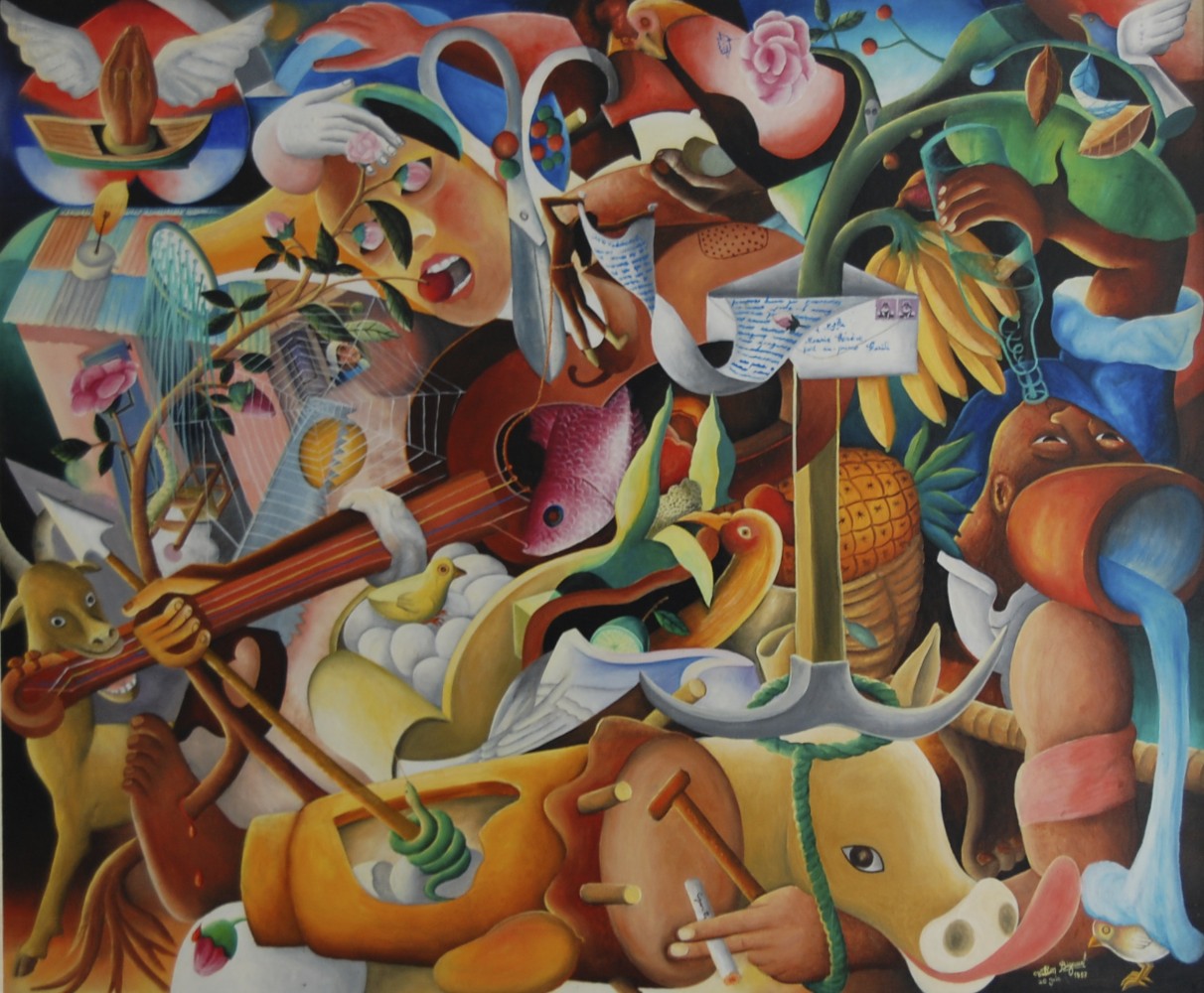
As those familiar with Bataille’s work will know, the spectacle of sacrifice and the “making of the sacred” were fundamental concerns for him, as they are for Dayan. “In the spectacles of sacrifice that concern me today” she said “to be disposable is not having the capacity to be dispossessed, to be nothing more than dispensable stuff”. With this in mind she made reference to the medieval law of the deodand, literally a “thing given up to God” symbolizing “forfeiture and power, loss and gain” and “an object or thing that becomes endowed with intent and malice and thus must be sacrificed or forfeited to the state, church or king”. Then, in a gesture which recalls the thought experiment known in consciousness studies as ‘the zombie problem’, she asked us to “imagine that this thing-like-thing returns in the shape of things that look like humans but are really evacuated of all characteristics that make social personhood possible…just at the moment that their life, their resistance is most present and visible”. For Dayan Wilson Bigaud’s portrait of a bull – Conflicts and Tensions (1957) – exhibited in the Kafou show captures what this thing-like-thing, that is so filled with spirit, might be.

Miluad Rigau Conflicts and Tensions

Continue reading “1804 and Its Afterlives (Part One)”